
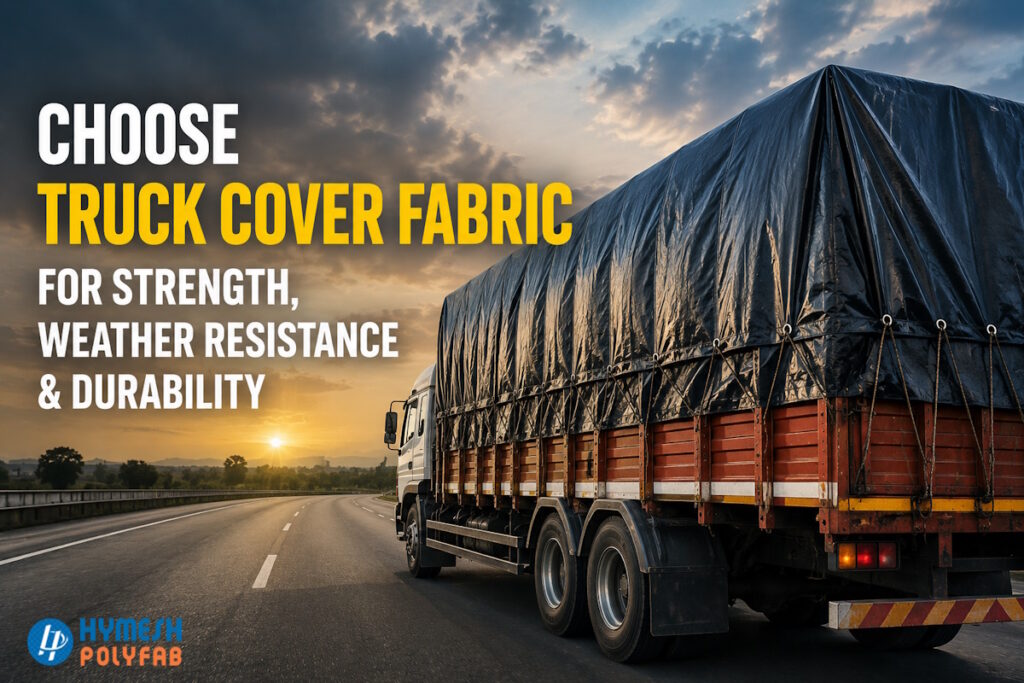
Open-bed highway transport exposes industrial cargo to some of the harshest physical environments in the supply chain.
Fleet managers, logistics operators, and transport fabricators routinely deal with cargo loss caused by fabric failure, ranging from sudden water seepage during monsoon downpours to catastrophic tearing triggered by high-speed wind buffeting.
When protective coverings fail on long-haul routes, the resulting moisture ingress, dust contamination, or physical cargo damage creates expensive insurance claims and strained commercial relationships.
Procuring the right cover material often becomes confusing because many commercial buyers evaluate fabrics purely on overall weight or nominal cost per kilogram. However, high nominal weight does not automatically guarantee high mechanical performance or environmental endurance. Making an informed bulk procurement decision requires a clear technical understanding of how polymer tape orientation, base weave density, lamination uniformity, and chemical additives interact. Specifying the proper truck cover fabric requires looking past superficial weight figures and examining the individual engineering parameters that govern durability under highway conditions.
The Structural Core: Polymer Selection and Base Weave Construction
Every reliable protective cover begins with a carefully engineered base weave. The primary structural choice for open-bed highway transport is woven high-density polyethylene tapes. Woven polyethylene provides exceptional tensile strength relative to its weight, high flexural fatigue resistance, and good flexibility across extreme temperature shifts. While polypropylene is widely used for indoor packaging sacks due to its high rigidity, high-density polyethylene performs significantly better in outdoor, dynamic environments where covers must flex repeatedly over irregular freight profiles without cracking.
Base fabric strength depends fundamentally on tape denier, polymer quality, and weave density (commonly measured as tapes per inch in both warp and weft directions). When evaluating HDPE polyfabric for heavy transport covers, procurement managers must look at tape orientation and orientation ratios. Properly drawn tapes exhibit high molecular orientation, which delivers the tensile strength necessary to resist wind loads at highway speeds. A loosely woven base covered with thick, cheap coating may seem heavy in hand, but it will lack the internal tensile network needed to survive continuous wind whip.
Industrial fabricators producing heavy-duty covers for multi-axle trailers typically specify an HDPE truck cover fabric engineered with virgin polymers rather than heavily recycled blends. Virgin resin ensures consistent elongation characteristics across the entire width of the roll. In contrast, inconsistent tape width or high concentrations of unverified calcium carbonate fillers produce brittle tapes that snap under vibrational stress, creating structural weak points along tie-down lines and sharp cargo edges.
GSM Breakdown: Evaluating Base Fabric and Coating Weight
Grams per square meter (GSM) is the most widely cited metric in industrial fabric procurement, yet it is also the most frequently misinterpreted. A fabric rated at 250 GSM can be manufactured in multiple ways. A low-grade configuration might use a light 120 GSM base fabric coated with 130 GSM of low-density polyethylene lamination containing high filler content. A high-performance configuration might utilize a dense 180 GSM base fabric protected by 70 GSM of pure, high-grade extrusion coating. While both fabrics weigh exactly 250 GSM on a scale, their mechanical performance on a trailer is vastly different.
The base fabric delivers almost all of the tensile strength, burst resistance, and dimensional stability. The extrusion coating exists primarily to seal the gaps between the woven tapes, prevent water ingress, and provide a binding layer for UV stabilizers and color pigments. When selecting a heavy duty truck cover fabric, buyers should request a clear breakdown of base fabric GSM versus lamination GSM. Relying strictly on total weight allows suppliers to cut costs by shifting weight from the expensive woven core to cheaper, heavily filled coating compounds.
For standard light commercial vehicles and short-haul city distribution, total fabric weights ranging between 140 and 180 GSM are often sufficient for manageable handling and moderate protection. Long-haul trailers, flatbed haulers moving raw industrial goods, and open-top agricultural transports typically require robust woven fabric for transport covers in the range of 200 to 350 GSM or higher. Choosing the right weight requires matching the operational profile: heavier fabrics offer greater puncture resistance against rough machinery, but excessively heavy fabrics can become cumbersome for drivers to fold, deploy, and secure properly, leading to operational delays.
Coating Integrity and Waterproof Performance Under Transit Stress
Achieving absolute moisture barrier performance on high-speed transport requires flawless extrusion lamination. Uncoated woven fabrics possess natural micro-interstices between intersecting warp and weft tapes. Under highway driving conditions, rain strikes the cover at significant velocity, while aerodynamic drag creates negative pressure zones that force water molecules through microscopic pinholes. A truly waterproof truck cover material relies on a uniform, pinhole-free film of low-density polyethylene extruded directly onto both sides of the base weave.
The quality of this barrier depends heavily on extrusion temperature control and resin purity during the coating process. If the lamination resin is applied at incorrect temperatures, it fails to achieve an intimate mechanical interlock with the base HDPE tapes. This results in poor peel strength or lamination delamination, especially along stress points where the fabric rubs continuously against cargo frames or tie-down ropes. Once delamination begins, water migrates horizontally between the coating layer and the base fabric, trapping moisture inside and rapidly compromising both the fabric and the protected cargo.
Similar engineering principles apply across other heavy transport sectors, such as bulk freight protection using a specialized railway wagon cover, where moisture exclusion must remain intact across hundreds of miles of exposure. For road logistics, buyers should verify coating adhesion through standard peel tests and check for pinhole frequency using light-table inspections before accepting bulk roll shipments from the manufacturing floor.
Need Help Selecting the Right GSM?
Managing UV Degradation During Highway Exposure
Solar radiation represents the single greatest environmental threat to polyolefin-based protective covers. Commercial transport vehicles spend days or weeks exposed to intense sunlight, high ambient temperatures, and changing humidity levels. Untreated polyethylene degrades rapidly when exposed to ultraviolet rays. Solar radiation breaks the chemical bonds within the polymer chains, leading to chain scission, severe embrittlement, loss of tensile elongation, chalking, and eventual cracking along fold lines.
To produce a reliable UV resistant truck cover fabric, manufacturers introduce chemical stabilizers directly into the polymer melt during both tape extrusion and lamination. Hindered Amine Light Stabilizers (HALS) and UV absorbers trap free radicals formed during photo-oxidation, effectively shielding the underlying polymer chains from rapid degradation. Procurement teams must clearly define expected operating life and outdoor exposure conditions with their fabric supplier. Formulations must balance stabilizer concentrations against processing parameters to avoid bloom or reduced heat-sealing efficiency during fabrication.
Color selection and carbon black pigment dispersion also play critical roles in solar management. High-purity carbon black serves as an exceptionally efficient natural UV screen. For open-air storage and transport demanding maximum sunlight resistance, utilizing black hdpe tarpaulin fabric remains one of the most reliable industrial solutions available. For cargo sensitive to internal heat buildup, such as temperature-critical chemicals or fresh agricultural produce, double-sided color configurations featuring silver or white exteriors reflect thermal radiation while maintaining strong UV stabilization throughout the core.
Tear Resistance, Wind Whip, and Mechanical Stress Points
While tensile strength measures the force required to pull an intact fabric strip apart until it breaks, tear strength measures the force required to propagate an existing cut or puncture. In open-bed highway transport, tear strength is arguably the more critical engineering metric. Highway covers routinely encounter sharp sheet metal corners, timber splinters, projecting bolts, and gravel thrown up from road surfaces. Once a minor puncture occurs, continuous aerodynamic fluttering (wind whip) concentrates massive dynamic forces directly at the puncture site.
If the fabric exhibits poor tear propagation resistance, a tiny two-millimeter puncture will rapidly rip open across the entire width of the trailer in high-speed traffic, releasing the cargo to the elements. Standard laboratory tests such as the tongue tear or trapezoidal tear test evaluate this property. Base fabrics woven from tapes with balanced elongation allow localized stress to distribute across neighboring tapes rather than snapping individual filaments sequentially. This dynamic load sharing prevents small snags from propagating into catastrophic tears.
Fabric strength must also be matched with proper physical dimensions and fastening design. Covers that fit poorly over cargo experience excessive loose material flapping, accelerating flex fatigue and wearing down the protective lamination layer. Logistics operators should consult standard commercial tarpaulin sizes to ensure adequate overlap without excess bulk that catches wind turbulence around the chassis.
Need Heavy-Duty Transport Cover Fabric?
Factory-Direct Sourcing and Verification Protocols
Sourcing truck cover fabric in bulk master rolls requires evaluating the technical capabilities and consistency of the manufacturing facility. Fabricators who convert master rolls into finished vehicle covers require dependable dimensional tolerances, clean roll edges, and consistent surface energy to facilitate smooth hot-air or high-frequency heat sealing. Variations in coating thickness across a roll can cause uneven seam welding, leaving weak seams that split open when the cover is secured under tension.
Working directly with an established HDPE fabric supplier in Gujarat provides buyers with access to large-scale, automated production facilities where extrusion parameters, tape tension, and lamination temperatures are controlled within tight industrial tolerances. Established manufacturers such as Hymesh Polyfab produce bulk woven fabrics engineered specifically to meet industrial transport requirements, maintaining consistent master roll quality from the inner core to the outer turn.
Before issuing commercial purchase orders for full container loads or ongoing monthly allocations, buyers should establish clear quality verification steps. Checking sample swatches for coating peel adhesion, verifying tensile strength across both machine and cross directions, and inspecting roll winding firmness will identify manufacturing variations before material enters the fabrication line.
What Procurement Teams Must Verify Before Ordering
Finalizing an industrial order for vehicle cover fabric requires specifying concrete operating parameters rather than relying on generic trade terms. Procurement teams should assemble a comprehensive technical brief that outlines exact logistical demands to ensure the manufacturer supplies an appropriately engineered roll specification. Before approving production runs, verify the following core parameters:
- Target Application and Vehicle Profile: Identify whether the material will serve as flatbed tie-down sheets, custom-fitted curtain sliders, container top covers, or open aggregate tipper tarps.
- Weight Allocation: Define both the base fabric GSM and the double-sided extrusion lamination GSM independently to avoid excess filler substitution.
- Mechanical Strength Metrics: Specify minimum required tensile strength in both warp and weft directions, alongside tongue tear resistance thresholds suited to expected transit speeds.
- Environmental Additive Package: Detail the outdoor exposure requirements, target operational lifespan, and necessary UV stabilization levels for high-radiation transport zones.
- Fabric Width and Roll Length: Confirm master roll dimensions that optimize cutting patterns for your cover fabrication operations, minimizing scrap loss during seam assembly.
- Sealing Compatibility: Verify that the lamination polymer formulation is fully compatible with your plant heat-sealing equipment, hot-wedge welders, or industrial stitching setups.
Discuss Your Transport Fabric Requirements