
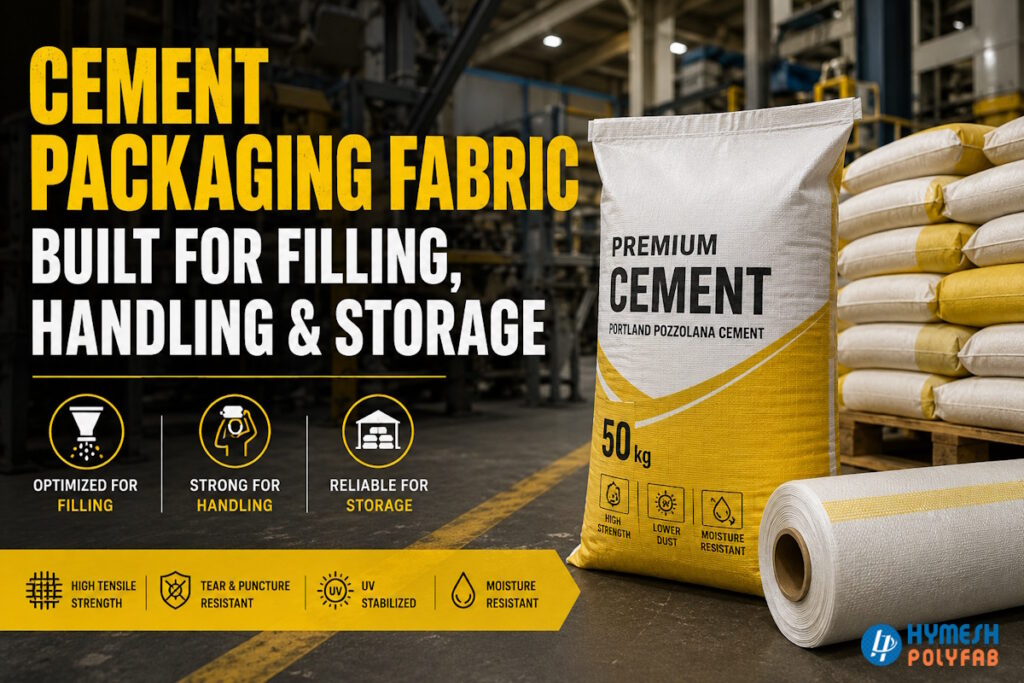
Cement manufacturing operates on demanding production schedules and unforgiving logistical realities.
When a 50 kg sack bursts on a high-speed rotary packer or degrades during transit in humid weather, the financial impact extends well beyond product wastage.
Broken sacks generate costly downtime, create severe dust hazards on the plant floor, damage corporate branding, and lead to contentious disputes with distributors. Selecting an inappropriate packaging material is frequently the hidden cause behind these persistent dispatch problems.
Specifying the ideal cement packaging fabric is not as simple as selecting the lowest-priced roll or relying solely on a generic gram-per-square-meter metric. Packaging engineers and procurement teams must align polymer properties, weave density, tensile strength, and coating consistency directly with line speeds, manual handling practices, and ambient storage environments. Taking a systematic approach to fabric selection ensures reliable containment from the packing spout all the way to the final construction site.
Operational Stresses in Modern Industrial Cement Packaging
To choose the correct fabric, procurement teams must first understand the mechanical and thermal forces exerted on a bag throughout its lifecycle. Cement leaves grinding mills and storage silos at elevated temperatures, often between 60 to 90 degrees Celsius. When packed into sacks, this residual heat softens poor-quality polymer tapes, drastically reducing the effective burst strength of bags manufactured with substandard raw materials.
Beyond thermal stress, the distribution chain in regions like India involves multiple high-impact touchpoints. A typical bag is filled pneumatically, dropped onto high-speed take-away belt conveyors, transferred via chutes, and hand-stacked onto flatbed trucks. At local distribution depots, manual laborers often unload sacks using handling hooks or drop them from vehicle beds directly onto uneven ground. Sacks produced with an inferior woven fabric for cement bags tear quickly under point loads, causing seam rupture or fabric splitting along the tape line.
Industrial packaging buyers must evaluate how their operations interact with these variables. For operations using automated palletizers and stretch-hood systems, dimensional stability and surface friction are paramount to prevent pallet slippage. Conversely, distribution chains reliant on manual labor require higher puncture resistance and tear propagation thresholds. Integrating robust industrial packaging solutions requires matching fabric tensile properties to real handling conditions rather than relying on idealized laboratory ratings.
How Filling Line Dynamics Dictate Fabric Selection
Pneumatic rotary and inline packing machines introduce significant internal pressure during the filling cycle. Cement powder is fluidified with compressed air to flow efficiently through the filling nozzle into the valve bag. If this displaced air cannot escape rapidly during the 3 to 5 seconds of filling, internal pressure spikes, causing the bag to burst at the seams or spit dust back through the sleeve.
Porosity vs. Barrier Balance
Unlaminated woven fabric provides natural breathability because air escapes through the micro-gaps between the warp and weft tapes. However, unlaminated fabric allows excessive cement seepage, creating significant airborne dust and product loss. To address this, many plants use a laminated cement packaging fabric equipped with mechanical micro-perforations. These tiny, engineered pinholes allow the fluidizing air to vent rapidly under line pressure while preventing fine cement particles from escaping.
Tensile Energy Absorption on Drop Conveyors
Once filled, the sack drops roughly 0.5 to 1 meter onto an exit conveyor. This drop generates a hydraulic shock wave inside the sack as the compacted powder shifts violently. The base fabric must possess adequate elongation and tensile energy absorption. If the tapes are drawn too stiffly during extrusion, they will snap under impact despite showing high tensile numbers on static tensile testing machines. High-grade PP woven fabric balances orientation and elasticity to absorb this sudden shock without permanent deformation.
Need the Right Cement Packaging Fabric?
Impact of Transit and Handling on Cement Sack Fabric
After leaving the packing terminal, cement sacks endure multi-modal transit where vibrational friction, shifting cargo, and rough manual labor constantly test the integrity of the polymer structure. Fabric failure during transit disrupts schedules and leads to rejected consignments at retail yards.
Vibrational fatigue occurs during long-haul road or rail transit. As stacked bags rub against each other and the wooden or steel surfaces of vehicle beds, unlaminated or poorly bonded coatings can experience surface abrasion. This abrasion weakens outer polymer tapes, making the bag susceptible to rupture when unloaded. Using virgin polypropylene resins combined with proper tape weaving ensures the fabric resists frictional wear over thousands of kilometers.
Manual handling introduces severe localized stress. In many markets, laborers still use metal handling hooks to lift 50 kg sacks. While no polymer weave is entirely immune to puncture by sharp hooks, a well-engineered cement sack fabric limits tear propagation. When punctured, poorly formulated fabric splits along the entire length of the tape, spilling the contents completely. In contrast, balanced weave fabrics confine the damage to the puncture point, preserving overall sack integrity until it reaches the site.
Stacking stability presents another critical concern. Sacks stacked 10 to 20 tiers high inside regional godowns place enormous hydrostatic pressure on the bottom layers. The base fabric must possess high creep resistance to prevent the bottom bags from bulging sideways and collapsing the entire stack. Evaluating polypropylene woven packaging for elongation consistency ensures stacks remain stable during prolonged warehousing.
Storage Conditions: Managing Moisture, Rain, and Solar Degradation
Cement is an intrinsically hygroscopic material that reacts chemically with atmospheric moisture, causing setting, lumping, and loss of binding strength. The selection of packaging fabric must directly reflect the climatic conditions of destination warehouses and outdoor transfer points.
Moisture Barrier and Lamination Integrity
Standard uncoated woven fabric offers virtually no moisture protection. In high-humidity environments, coastal corridors, or monsoon seasons, a laminated cement packaging fabric is mandatory. The continuous extrusion coating acts as a moisture vapor barrier, shielding the dry cement powder inside. However, lamination quality varies widely among manufacturers. Uneven coating thickness or poor corona treatment leads to micro-cracks and lamination delamination, allowing ambient humidity to penetrate the package over time.
Ultraviolet Radiation Exposure
Bags often sit in open rail yards, outdoor construction sites, or uncovered distributor docks for weeks. Standard polypropylene degrades rapidly under solar ultraviolet radiation, losing tensile strength and becoming brittle. Industrial cement packaging intended for open-air storage or export must incorporate appropriate UV stabilization masterbatches. Specifying UV resistance ensures the fabric maintains structural strength during sun exposure, preventing catastrophic splits when the sack is finally hoisted onto scaffolding.
Comparing polymer properties is also vital when storage conditions involve extreme temperature swings. Reviewing standards for hdpe woven packaging alongside polypropylene options allows buyers to tailor impact resistance and thermal stability to their specific geographic distribution network.
Need Help Finalizing Your Fabric Specification?
Essential Cement Bag Fabric Specifications
Procurement teams should develop precise technical specification sheets rather than relying on generic commercial terms. Fabric quality is governed by an interconnected set of parameters that dictate real-world performance.
- GSM Breakdown: Fabric weight must always be evaluated as base fabric GSM plus extrusion coating GSM. For example, a 70 GSM total fabric might consist of a 52 GSM base weave and an 18 GSM lamination layer. Specifying both values prevents suppliers from masking weak base fabric with heavy, brittle coating layers.
- Tape Width and Mesh Density: Cement sacks generally employ a weave construction of 10×10 or 12×12 tapes per inch. Balanced tape count ensures uniform load distribution across both warp and weft directions during multi-tier drop impacts.
- Virgin Polymer vs. Filler Content: Calcium carbonate filler is often added to reduce manufacturing costs. Excessive filler content, however, ruins tape elasticity, compromises weldability on bag-making machines, and increases burst rates. Specifying acceptable filler percentages guarantees tape elasticity.
- Breaking Strength and Elongation: The fabric must meet defined minimum breaking loads in both machine (warp) and cross (weft) directions. Elongation at break should typically sit between 15% and 25% to allow adequate shock absorption without excessive dimensional elongation.
- Coating Adhesion: Peel strength tests ensure that the extrusion coating does not separate from the underlying woven fabric during high-speed folding, creasing, and valve formation.
Making the Right Bulk Procurement Decision
Sourcing cement packaging fabric directly from experienced manufacturers provides substantial cost and quality advantages, but it requires clarity during the inquiry phase. Packaging failures frequently trace back to miscommunications between plant operations and procurement desks regarding operational line demands.
Before issuing requests for quotation or signing annual supply contracts, buyers should systematically verify several operational details:
- Packing Line Equipment: Specify your exact filling technology, whether rotary impeller, air-assisted packer, or mechanical screw, alongside typical packing temperatures and cycle times.
- Venting Configurations: Establish whether the fabric requires inline micro-perforation, nano-perforation, or specialized porous coating to permit de-aeration without environmental dust leaks.
- Distribution Footprint: Clarify whether the final sacks are intended for direct domestic road supply, multi-week coastal rail transit, or international export shipping with extended maritime exposure.
- Fabric Width and Roll Specifications: For bag conversion plants, confirm roll diameter, core size, edge trimming quality, and winding tension to prevent misalignment on automated tubing lines.
- Batch Testing Protocols: Agree on acceptable inspection methods for tensile strength, elongation, burst resistance, and coating bond prior to factory dispatch.
Working with an integrated manufacturing partner such as Hymesh Polyfab ensures your fabric rolls are extruded, woven, and coated under stringent quality control. When you are ready to evaluate trial samples or establish bulk delivery schedules, take time to contact PP woven fabric supplier technical specialists to review your packaging parameters.
Discuss Your Woven Fabric Requirements