
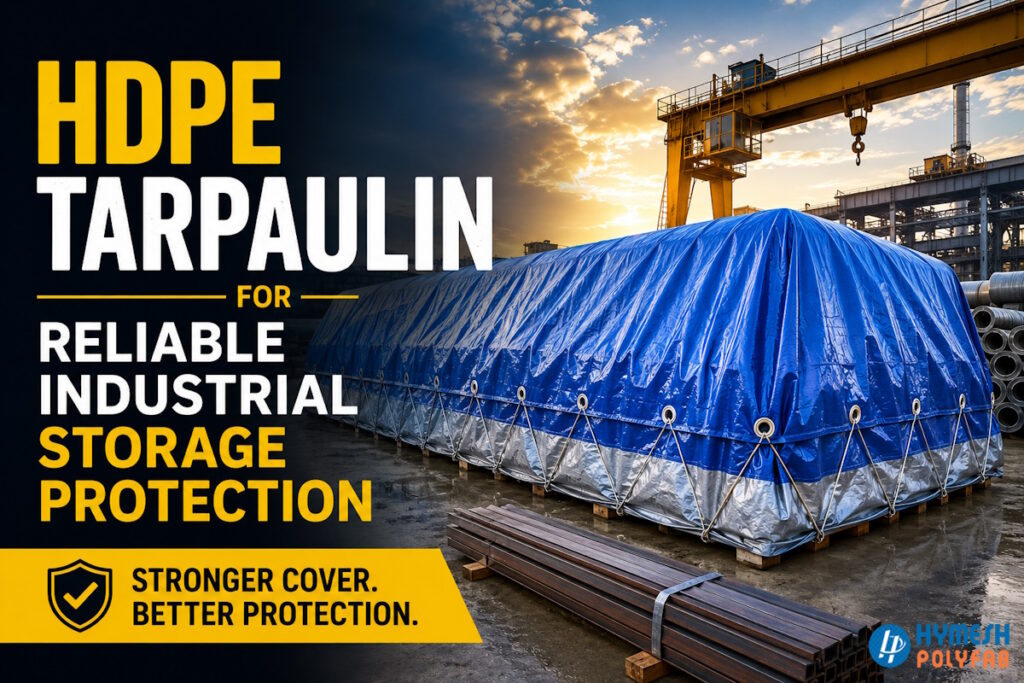
Industrial storage yards, construction sites, and manufacturing hubs depend on protective covers to shield raw materials, machinery, and finished inventory from outdoor elements.
When bulk goods remain outdoors for weeks or months, ordinary covers deteriorate rapidly under intense sunlight, high winds, and heavy precipitation.
Inadequate tensile strength or degraded lamination creates pinholes, fabric splitting, and moisture seepage that can damage valuable industrial stock.
Specifying a heavy-duty HDPE tarpaulin requires more than selecting an arbitrary thickness or price point. Plant managers and procurement specialists must assess the interaction between fabric weight, lamination gauge, environmental stabilizers, and structural reinforcements. Making informed choices during the specification stage prevents sudden structural failures, reduces replacement cycles, and guarantees continuous protection across demanding industrial environments.
Understanding GSM Selection for Industrial Tarpaulin Sheets
The overall weight of an industrial cover directly reflects its structural density and mechanical capability. When evaluating HDPE tarpaulin GSM, buyers must recognize that the total figure represents a composite structure: a central woven scrim made of high-density polyethylene tapes laminated on both sides with low-density polyethylene film. A higher weight typically provides greater tear resistance and puncture durability, but the distribution between the woven tape base and the surface coating matters just as much as the gross number.
Different industrial storage applications demand distinct weight profiles to balance handling practicality with physical resilience:
- Light to Medium Duty (120 to 180 GSM): Suitable for short-term equipment covers, temporary pallet protection, and indoor dust shielding where mechanical abrasion and prolonged wind stress remain minimal.
- Standard Industrial Grade (200 to 250 GSM): Ideal for mid-term outdoor storage, warehouse staging, and standard logistics transit covers where reliable moisture resistance and moderate tear resistance are essential.
- Heavy Duty HDPE Tarpaulin (300 to 450+ GSM): Required for severe long-term yard storage, open-air raw material stockpiles, aggregate protection, and harsh climatic conditions involving continuous wind whip and abrasion.
Selecting an excessively heavy grade for temporary use increases manual handling strain and procurement expense unnecessarily. Conversely, deploying a light cover over sharp, irregular steel components or machinery edges inevitably causes premature puncture. Evaluating the specific surface profile of the stored goods ensures the chosen GSM delivers dependable protection without wasted material investment.
UV Stabilization and Outdoor Environmental Durability
Solar radiation represents the single greatest threat to polymers deployed in open storage yards. Without specialized chemical additives, polyethylene chains undergo photo-oxidative degradation when exposed to ultraviolet light. This chemical breakdown causes the fabric to become brittle, leading to micro-cracking across the lamination layer and catastrophic tearing along the woven tapes.
Procuring a dependable UV treated HDPE tarpaulin requires verifying that ultraviolet stabilizers are thoroughly compounded into both the base fabric tapes and the exterior extrusion coatings. Hindered Amine Light Stabilizers (HALS) neutralize free radicals generated during solar exposure, preserving tensile strength and flexibility across extended storage periods.
For operations located in regions with severe solar exposure, selecting a black hdpe tarpaulin provides natural UV absorption advantages because carbon black acts as an inherently effective light blocker. In applications requiring light reflection to minimize internal heat accumulation over chemical drums or temperature-sensitive goods, dual-color combinations such as silver-black or blue-silver optimize thermal management alongside solar resistance.
Need Industrial HDPE Tarpaulin Specifications?
Determining Dimensions, Panel Seaming, and Sizing Logic
Sizing errors represent a widespread yet preventable problem in industrial yard management. Specifying the correct footprint requires calculating not only the top surface area of the stockpile or equipment, but also accounting for vertical drop, ground anchoring clearances, and water run-off angles. A cover that fits too tightly creates severe tension points across sharp corners, while an oversized sheet allows excessive loose fabric to catch the wind, causing continuous whipping and edge fatigue.
Procurement teams should understand the difference between cut size and finished size. Standard manufacturing processes fold edges inward to create reinforced perimeter hems and join narrower fabric panels to reach broad widths. This fabrication process can reduce final dimensions by several inches unless the manufacturer produces the order to exact finished dimensions. Reviewing standard tarpaulin sizes prior to ordering prevents unexpected dimensional shortages on site.
Wide-span coverage demands advanced thermal seaming. Because industrial looms produce woven rolls in defined widths, creating a large-scale industrial tarpaulin sheet requires heat-welding multiple panels together. High-quality hot-wedge or hot-air sealing fuses the overlapping lamination layers, forming a leak-proof structural bond that matches the tensile performance of the virgin HDPE fabric base.
Edge Reinforcement, Hem Construction, and Eyelet Engineering
The vast majority of field failures occur at the perimeter rather than in the central fabric area. High winds generate concentrated uplift forces along the edges of an anchored cover. If the boundary construction lacks proper reinforcement, grommets can pull clean through the plastic, allowing wind to enter beneath the sheet and strip the entire cover away from the stored inventory.
A properly engineered reinforced HDPE tarpaulin incorporates multiple structural safeguards along every outer edge:
- Rope-Reinforced Hems: Strong polypropylene ropes are embedded inside heat-welded perimeter folds to distribute anchoring stress evenly along the entire edge instead of concentrating load on isolated grommets.
- Corner Reinforcement Patches: Multi-layer fabric gussets or molded polymer triangles are welded onto every corner to absorb multidirectional tension during ground tie-down.
- Eyelet Composition and Spacing: Heavy-gauge aluminum, brass, or reinforced polycarbonate eyelets resist galvanic corrosion and mechanical distortion under load. For industrial storage, eyelets should be placed at three-foot or shorter intervals to minimize wind flutter.
- Sonic or Heat-Welded Bonding: Ultrasonic or heat-fusion hems prevent moisture from penetrating the internal scrim channel, eliminating the risk of internal mold growth or tape unraveling.
Discuss Custom Tarpaulin Reinforcement Details
Handling Mechanical Demands and Yard Storage Realities
Industrial storage facilities expose protective covers to rough operational handling that standard commercial sheets cannot endure. Forklift tines, timber pallet splinters, rough gravel surfaces, and metal banding repeatedly scuff the exterior coating. When evaluating materials for outdoor stockpiles, buyers must consider how the fabric behaves under abrasion, flex fatigue, and continuous tension.
Engineered polyolefin covers bridge the gap between flexible protective sheets and rigid storage infrastructure. Just as specialized woven packaging prevents product degradation inside transit containers, a durable woven cover provides an external barrier against airborne dust, industrial soot, acid rain, and moisture ingress. Maintaining clean lamination surfaces and tight weave density ensures that abrasive particles cannot penetrate into the interior tapes, preventing gradual fiber erosion from within.
Storage management protocols also influence tarpaulin longevity. Storing covers off the ground in cool, dry conditions when not in service prevents rodents, moisture pockets, and chemical contact from compromising the polymer structure. Training field personnel to secure tie-downs firmly without tying lines directly around bare corners prevents focal friction wear.
What Procurement Teams Must Verify Before Ordering
Securing long-lasting storage covers requires transparent technical dialogue between procurement specialists and the fabric manufacturer. Relying solely on low price per square meter often results in receiving covers made with recycled, degraded polymers, inconsistent tape extrusion, or unverified lamination thickness that splits during the first windstorm.
Before issuing a bulk purchase order, industrial buyers should verify the following technical parameters with their manufacturer:
- Resin Integrity: Confirm whether the woven scrim and coating utilize 100 percent virgin polymer resins to ensure predictable tensile and elongation properties.
- True Finished Dimensions: Clarify whether quoted measurements refer to cut size or finished size after perimeter hemming and panel seaming.
- Target GSM Verification: Request precise breakdowns between base scrim GSM and exterior lamination micron thickness on both sides.
- UV Additive Concentration: Specify anticipated outdoor exposure duration and geographical location to ensure appropriate stabilizer percentages are compounded into the masterbatch.
- Hardware Specifications: Confirm eyelet material, diameter, insertion pitch, and the presence of reinforced corner gussets.
Direct communication ensures your facility receives sheets engineered for exact yard conditions rather than generic utility plastic. To establish custom dimensions, examine testing certifications, or organize bulk plant supply, technical buyers should contact HDPE fabric supplier teams directly to evaluate technical options before production commences.
Need Bulk Industrial Tarpaulin Quotations?