
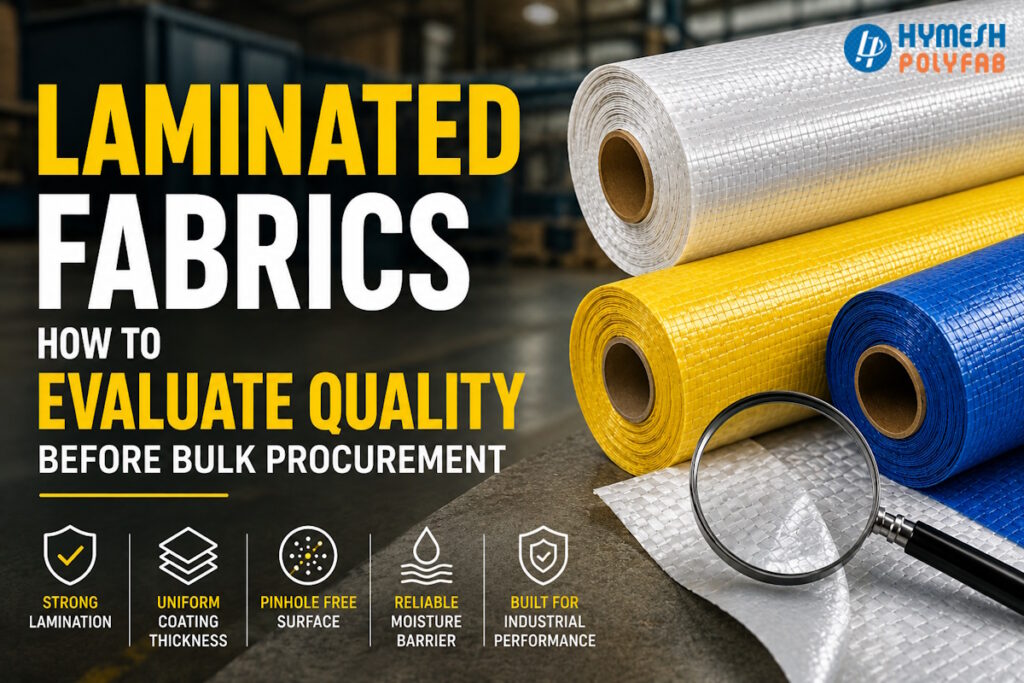
In high-volume industrial packaging and protective wrapping, specifying laminated woven material is standard practice for barrier protection.
However, procurement teams often discover that visual inspection alone fails to reveal critical bonding defects.
When fabrics are subjected to mechanical handling, high-speed bag conversion, outdoor exposure, or heavy stacking loads, poor lamination rapidly leads to layer separation, pinholes, and moisture ingress that can ruin sensitive bulk cargo.
Evaluating the true quality of laminated polyolefin substrates before committing to high-tonnage orders requires an understanding of extrusion coating dynamics. Factors such as polymer temperature during extrusion, corona treatment levels, surface cleanliness of the base weave, and micron consistency across the roll determine how well the coating performs in the field. Establishing rigorous pre-procurement quality checks ensures that packaging converters and industrial buyers invest in materials engineered for severe operational stress.
Understanding the Extrusion Coating Process on Woven Substrates
The performance of laminated woven fabric depends directly on the extrusion lamination process, where a molten thin film of polyethylene or polypropylene is continuously applied onto a woven base scrim. For industrial applications, the bond between the molten polymer film and the underlying flat tapes must be mechanical and chemical in nature. If the molten polymer temperature drops below the required threshold or the chill roll pressure is uneven, the coating will merely sit on the surface rather than anchoring between the tape gaps.
Base fabric construction directly influences how well the coating adheres. High-density polyethylene base structures, such as standard HDPE woven fabric, have specific thermal shrinkage behaviors during the coating stage. When the extruded film cools, differential contraction between the base weave and the laminated layer can introduce micro-stresses. A proficient woven fabric manufacturing company precisely manages extrusion melt index, chill roll temperature, and web tension to achieve a stable, bonded composite.
Critical Parameters for Evaluating Woven Fabric Lamination Quality
Assessing laminated fabric quality involves moving beyond basic weight metrics to analyze physical bond integrity and barrier continuity. Industrial buyers must evaluate specific failure points that typically emerge during converting or transport.
Assessing Lamination Adhesion Strength
Lamination adhesion is the primary indicator of coating durability. Weak bonding causes the lamination layer to peel away when the fabric is folded, creased, stitched, or subjected to friction. Procurement teams can perform standardized peel adhesion tests or manual cross-hatch tape tests to verify that the coating film cannot be separated from the woven scrim with minimal force. In properly laminated materials, the bond strength often approaches or exceeds the tensile strength of the coating layer itself.
Verifying Coating Uniformity and Gauge Consistency
Coating uniformity across the entire usable width of the roll is essential for consistent barrier properties. If an extruder die experiences uneven pressure or thermal variance, the coating thickness will fluctuate across the roll edges and center. Uneven coating leads to weak spots where pinholes easily form under light tension. Ultrasonic or mechanical micrometer testing across transverse roll strips ensures the lamination layer adheres to specified micron limits consistently.
Checking for Pinholes, Bubbles, and Visual Voids
A continuous barrier is non-negotiable for cement, chemical, fertilizer, and agricultural packaging. Defects such as air entrapment bubbles, micro-pinholes, or un-melted polymer gels compromise the fabric moisture barrier. A practical backlit inspection test across production samples quickly highlights voids, uneven coating distribution, or optical distortions that indicate poor extrusion control.
Need Help Selecting the Right Lamination Specification?
Matching Laminated Woven Fabric Specifications to Application Demands
Every industrial packaging application presents distinct environmental and mechanical challenges. Sourcing laminated fabrics requires tailoring the GSM, base weave density, and coating thickness to the specific product handled, storage duration, and transportation method.
For chemical and food-grade packaging, pp laminated woven fabric is often specified due to its higher melting point, surface stiffness, and suitability for hot-fill processes or high-speed automated bag-making lines. Conversely, heavy-duty outdoor tarpaulins, lumber wraps, and bulk ground covers frequently utilize HDPE-based woven materials laminated with low-density polyethylene coatings for superior low-temperature flexibility and tear propagation resistance.
When drafting laminated woven fabric specifications, procurement managers must explicitly define several performance parameters:
- Base Scrim GSM vs. Lamination GSM: Stating the exact breakdown (such as 80 GSM base fabric plus 20 GSM coating) rather than a simple total GSM figure ensures the structural strength and barrier thickness are correctly distributed.
- Corona Treatment Level: If the fabric will undergo flexographic or rotogravure printing, surface dyne levels must be maintained at standard printing thresholds to avoid ink flaking.
- Single-Side vs. Sandwich Lamination: Multi-ply applications requiring BOPP film integration or double-sided coating need balanced lamination layers to prevent curling and dimensional distortion.
- UV Stabilization in Both Layers: In outdoor storage scenarios, adding UV masterbatch only to the base weave while leaving the coating unprotected causes rapid film degradation and premature flaking.
Discuss Your Woven Fabric Requirements
Common Sourcing Mistakes in Woven Fabric Lamination Procurement
A frequent error in industrial procurement is evaluating fabric solely on a per-kilogram price point without auditing coating formulation. Lower-grade reprocessed calcium carbonate fillers are sometimes excessively blended into the coating masterbatch to reduce raw material costs. While this achieves the specified total weight, it drastically impairs lamination adhesion, creates micro-porosity, and reduces fabric elasticity.
Another major oversight occurs when buyers fail to test the material under simulated conversion conditions. Fabrics that appear adequate in roll form may crack along sharp gussets or crease lines during bag forming if the coating polymer lacks sufficient elongation properties. When finalizing procurement terms or submitting an HDPE woven fabric enquiry, requesting certified production samples for fold endurance and crease-barrier testing prevents high rejection rates during plant conversion.
What Buyers Should Verify Before Placing a Bulk Order
To ensure total batch consistency across long production runs, procurement specialists should implement a structured pre-shipment verification checklist. Industrial suppliers should be evaluated on their continuous quality control protocols and laboratory testing capabilities before contract finalization.
Before releasing production approval for custom laminated materials, confirm the following technical data:
- Coating Polymer Grade: Ensure virgin coating polymer is used when food contact, fine chemical containment, or long shelf-life barrier properties are mandatory.
- Peel Test Documentation: Request internal quality inspection reports demonstrating consistent adhesion values across roll beginnings, middles, and ends.
- Dart Impact and Puncture Resistance: Confirm that the laminated composite retains adequate impact strength to withstand sharp material edges or handling drops.
- Roll Edge Trimming and Winding Quality: Verify that selvages are cleanly trimmed without loose lamination fringes and that rolls are wound with uniform tension to prevent telescoping during processing.
Need Help Finalizing Your Fabric Specification?