
Managing water containment in large-scale agricultural operations presents a continuous engineering challenge.
In regions reliant on seasonal rainfall, irrigation reservoirs must retain millions of liters of water without suffering from subsurface seepage, structural degradation, or environmental wear.
When selecting containment materials, procurement managers and agricultural developers often struggle to balance initial material costs with the long-term operational costs of water loss. A failure in reservoir lining does not just mean losing water, it can lead to soil erosion, localized flooding, and compromised crop cycles.
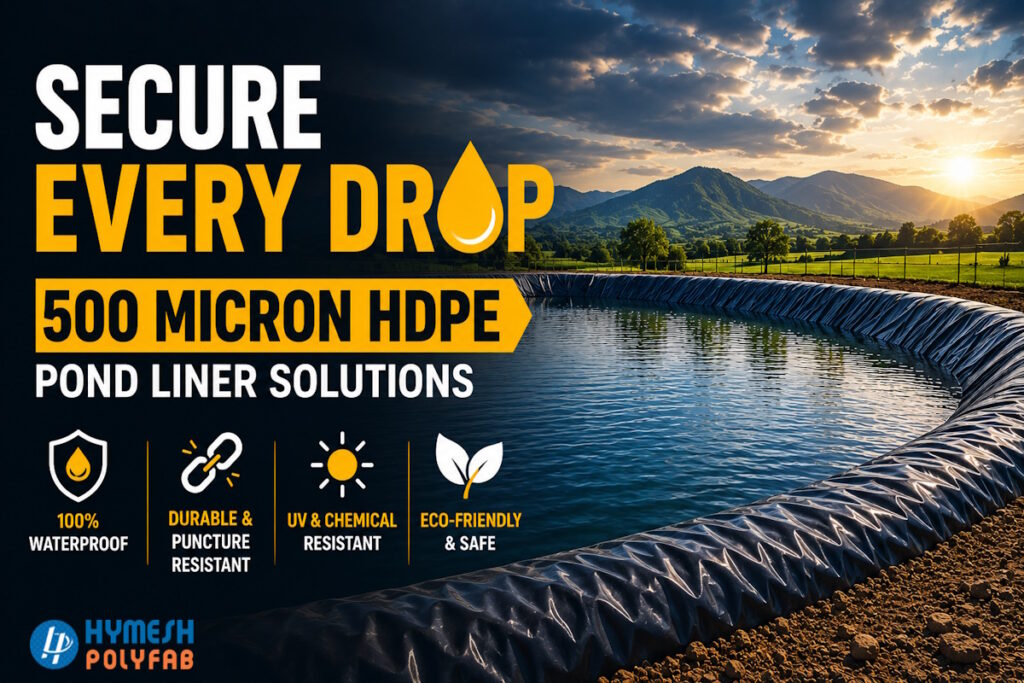
To address these challenges, the agricultural sector increasingly relies on high-performance geomembranes. Among the various specifications available, the agricultural hdpe pond liner 500 micron solution has emerged as an industry standard for mid-to-large-scale irrigation reservoirs. This article examines the technical composition, polymer performance, and procurement considerations that industrial buyers must analyze before securing bulk containment materials from a reliable manufacturer.
Planning a large irrigation reservoir project?
Understanding the Material Science: PE vs HDPE in Pond Lining
Selecting the correct liner material requires a fundamental understanding of polymer chemistry and its structural behavior under physical stress. Buyers frequently encounter terms like polyethylene material, low-density polyethylene, and high-density polyethylene, which can lead to confusion during the procurement phase.
The Transition from Standard Polyethylene to High-Density Polymers
The debate surrounding PE vs HDPE is centered on molecular structure and density. Standard low-density or linear low-density polyethylene materials offer high flexibility but lack the structural rigidity and puncture resistance required for massive water volumes. High-density polyethylene, on the other hand, features a highly crystalline structure with minimal branching in its polymer chains. This molecular configuration gives the material superior tensile strength, making it the preferred polyethylene material for heavy-duty industrial and agricultural applications.
Chemical Resistance and Tensile Performance of Polyethylene Material
The high-density configuration of HDPE provides exceptional resistance to chemical degradation, soil-borne microbes, and agricultural runoff containing fertilizers. In large reservoirs, the liner is continuously exposed to dissolved minerals and organic matter. Standard PE can degrade, become brittle, or leach chemicals over time when exposed to these elements. High-density options ensure that the barrier remains inert and structurally sound throughout its operational lifespan.
Why Woven HDPE Fabric Rolls Outperform Non-Woven Alternatives
While smooth geomembranes are common, a high-quality hdpe woven fabric composite offers distinct structural advantages. By integrating a high-strength woven core with double-sided extrusion lamination, manufacturers produce a liner that resists tearing and punctures far better than non-reinforced films. This composite approach prevents small punctures from propagating into massive tears under the hydrostatic pressure of a full reservoir.
Technical Specifications of a 500 Micron HDPE Pond Liner
To ensure long-term performance, buyers must understand how physical measurements translate into field durability. A 500-micron liner, which is approximately 0.5 millimeters thick, represents the optimal balance between flexibility, weight, and puncture resistance for agricultural reservoirs.
Deconstructing the 500 Micron Thickness, GSM, and Weight Metrics
In the technical textile industry, thickness alone does not dictate strength. The weight of the liner, measured in grams per square meter, provides a clearer picture of its structural density. A high-quality hdpe pond liner 500 micron manufactured from reinforced woven material typically ranges from 400 to 450 GSM. This weight ensures that the liner is heavy enough to lay flat during installation while remaining light enough to transport as a consolidated hdpe fabric roll, reducing logistics costs.
Multi-Layer Lamination and UV Stabilization
Because irrigation reservoirs are exposed to direct sunlight, ultraviolet degradation is a primary threat to liner integrity. Industrial-grade HDPE liners feature a multi-layer structure where the woven core is coated with UV-stabilized polymer layers on both sides. Carbon black and specialized UV inhibitors are blended directly into the polymer matrix during the extrusion process. This prevents the molecular bonds from breaking down when exposed to intense solar radiation.
Load-Bearing Capacity and Tear Resistance for Large Reservoirs
Large reservoirs hold water at significant depths, exerting immense hydrostatic pressure on the containment base and sloped banks. A woven composite liner distributes this load evenly across its surface. The warp and weft tensile strength of the woven core ensures that the liner does not stretch excessively or deform under weight, maintaining its barrier properties even when the subgrade shifts slightly over time.
Want to verify GSM, thickness, and specifications?
Applications in Large Irrigation Reservoirs and Agriculture
Implementing an engineered barrier is critical for modern agricultural water management, particularly in drought-prone regions where every drop of water directly impacts crop yield and farm profitability.
Seepage Control and Water Conservation Efficiencies
Unlined reservoirs can lose up to forty percent of their stored water due to soil seepage, depending on local soil porosity. This water loss represents wasted pumping energy, lost rainwater collection, and reduced irrigation capacity. Installing a 500-micron HDPE liner virtually eliminates seepage loss, allowing agricultural enterprises to retain precise water volumes and plan irrigation schedules with high predictability.
Soil Erosion Prevention and Slope Stabilization
When water levels in a reservoir fluctuate, the movement of water along the earthen banks can cause severe erosion. Over time, this erosion compromises the structural integrity of the reservoir walls, leading to bank collapse. A durable hdpe fabric roll applied to the slopes acts as a protective shield, preventing water from washing away the soil and maintaining the engineered shape of the reservoir.
Procurement and Installation Best Practices for Industrial Buyers
Sourcing and installing thousands of square meters of geomembrane requires careful planning to avoid common procurement errors that lead to project delays or premature liner failure.
Key Selection Criteria: What to Ask Your Woven Fabric Manufacturer
When evaluating manufacturers, buyers must look beyond the price per square meter. To guarantee quality, inquire about the raw material sourcing, lamination consistency, and quality control protocols. Ensure the manufacturer uses virgin resin rather than recycled plastics, as recycled materials often contain contaminants that drastically reduce UV resistance and tensile strength. Ask for testing certificates validating tensile strength, elongation, tear resistance, and hydrostatic pressure resistance.
Common Installation Pitfalls in Large-Scale Agricultural Projects
Even the highest-quality hdpe pond liner 500 micron can fail if installed incorrectly. The most common installation errors include poor subgrade preparation and inadequate panel jointing. Before deploying the liner, the reservoir bed must be thoroughly compacted and cleared of sharp rocks, roots, and debris. Additionally, panels must be welded using professional hot-wedge or extrusion welding equipment. Poorly sealed seams are the primary source of leaks in agricultural containment systems.
Procurement Guidance: Selecting the Right Partner for Bulk Supply
For large-scale agricultural developments and export projects, partnering with an experienced manufacturer ensures material consistency and supply chain reliability. Custom panel fabrication, optimized roll widths to minimize on-site welding, and strict adherence to international quality standards are crucial for project success. By specifying high-density hdpe woven fabric solutions, buyers can secure a durable, cost-effective containment barrier that protects agricultural assets and maximizes water conservation for years to come.
Ready to source durable 500 micron HDPE pond liners?