
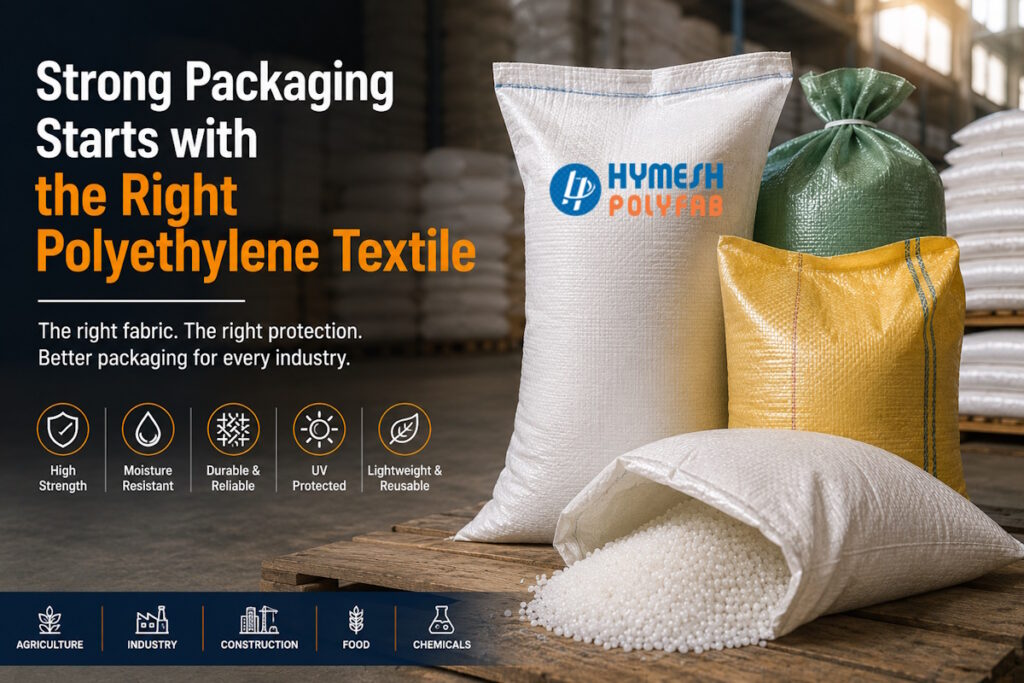
Packaging plays a major role in protecting products during storage, handling, and transport. The right packaging material can prevent damage, reduce waste, control costs, and improve the overall customer experience. One material that is widely used in modern packaging is polyethylene textile.
Polyethylene textile is known for its strength, light weight, moisture resistance, and long service life. It can be used to make sacks, covers, wrapping sheets, liners, tarpaulins, and many other packaging products. However, not every type of polyethylene material is suitable for every packaging job.
Some products need strong protection from rain. Others need air flow. Some packages must hold heavy goods, while others only need a light protective layer. This is why choosing the right polyethylene textile is important.
In this guide, you will learn what polyethylene textile is, how it is made, where it is used, and what factors you should check before selecting it for packaging.
Need the right polyethylene textile for your packaging needs?
What Is Polyethylene Textile?
Polyethylene textile is a flexible material made from polyethylene plastic. Polyethylene is one of the most common plastic materials in the world. It is valued because it is light, strong, water-resistant, and easy to shape.
To produce textile material, polyethylene is turned into thin strips, threads, films, or fibers. These parts can then be woven, laminated, coated, or layered to create a packaging fabric.
One common type is polyethylene woven fabric. It is made by weaving polyethylene tapes in two directions. This woven structure gives the fabric good strength and helps it resist tearing.
Another common term is woven polyethylene fabric. In most cases, this refers to the same type of material. It is often used for industrial sacks, protective covers, bulk bags, agricultural sheets, and transport packaging.
Polyethylene textile is available in different thicknesses, weights, colors, finishes, and strength levels. It can also be printed with logos, product details, safety messages, and handling instructions.
Why Polyethylene Textile Is Popular in Packaging
Packaging materials need to protect goods without adding too much cost or weight. Polyethylene textile offers a useful balance between strength, flexibility, and price.
It is popular for several reasons.
First, it is lightweight. A lighter package is easier to move and may reduce transport costs. This can be important when a company ships large volumes of goods.
Second, polyethylene textile can resist water and moisture. This helps protect products such as grains, animal feed, fertilizer, cement, chemicals, and building materials.
Third, it has good tear strength. A woven structure can spread pressure across a larger area, which helps stop small cuts from turning into major tears.
Fourth, it is flexible. It can bend, fold, roll, and fit around products of different shapes.
Fifth, it can be made for many packaging needs. Manufacturers can change the fabric weight, weave, coating, size, color, and finish based on the product being packed.
These benefits explain the growing number of polyethylene fabric uses in agriculture, construction, food packaging, shipping, retail, and industrial storage.
Main Types of Polyethylene Textile
Before choosing a packaging material, it helps to understand the main types available.
1. HDPE Woven Fabric
HDPE woven fabric is made from high-density polyethylene. HDPE is a strong and firm type of polyethylene. It is used when the packaging needs to carry weight or handle rough treatment.
HDPE tapes are stretched before they are woven. This stretching improves their strength. The tapes are then woven together to form a strong sheet or tube.
HDPE woven fabric is often used for:
- Grain sacks
- Rice bags
- Sugar bags
- Flour bags
- Fertilizer sacks
- Cement bags
- Sandbags
- Animal feed bags
- Chemical packaging
- Large protective covers
This fabric is a good choice for dry products that need strong packaging. It can also be laminated to improve moisture protection.
2. Laminated Polyethylene Woven Fabric
A standard woven fabric has tiny spaces between the woven tapes. These spaces may allow fine dust, air, or small amounts of moisture to pass through.
Lamination adds a thin film over the fabric. This closes many of the small gaps and creates a smoother surface.
Laminated polyethylene woven fabric can offer:
- Better water resistance
- Better dust control
- Improved print quality
- Greater protection for fine powders
- A cleaner outer surface
- Added resistance to dirt and stains
This material is often selected for cement, fertilizer, chemicals, food ingredients, and other products that need more protection than plain woven fabric can provide.
3. Unlaminated Woven Polyethylene Fabric
Unlaminated woven polyethylene fabric does not have an added film layer. It is usually more breathable than laminated fabric.
This type may be suitable for products that need some air movement, such as certain agricultural goods. It may also cost less because it uses fewer layers.
However, it may not be the right option for products that are sensitive to moisture, fine dust, or outside dirt.
4. Coated Polyethylene Fabric
Coated polyethylene fabric has a protective surface treatment. The coating can improve water resistance, surface strength, or print performance.
The exact features depend on the coating material and the way it is applied. Some coated fabrics are made for outdoor use, while others are designed for packaging that needs a smooth and clean finish.
5. Polyethylene Film Fabric
Some packaging products use polyethylene film instead of a woven structure. Film materials can provide strong protection against water and air.
However, normal film may not have the same tear resistance as woven material. For this reason, film is often used as a liner or as part of a layered packaging system.
A package may include an outer HDPE woven fabric layer for strength and an inner polyethylene film liner for moisture control.
Understand the Product You Need to Pack
The first step in choosing the right polyethylene textile is to study the product.
Every product has different packaging needs. You should consider its weight, shape, texture, moisture level, and sensitivity.
Ask the following questions:
- Is the product heavy or light?
- Is it dry, damp, or liquid?
- Does it contain sharp edges?
- Is it a fine powder?
- Can it be damaged by moisture?
- Does it need air flow?
- Will it be stored indoors or outdoors?
- Is it a food product?
- Is it sensitive to sunlight?
- How long will it remain inside the package?
For example, rice needs packaging that is strong and clean. Cement needs a package that controls dust and resists tearing. Fertilizer may need protection from moisture. Fresh agricultural products may need some air flow.
The best polyethylene textile is the one that matches the needs of the product, not simply the strongest or thickest option.
Check the Fabric Strength
Strength is one of the most important points when choosing polyethylene textile for packaging.
The fabric must hold the product without breaking during filling, lifting, stacking, transport, or unloading.
Several factors affect fabric strength.
Fabric Weight
Fabric weight is often measured in grams per square meter, also called GSM. A higher GSM usually means that more material is used in each square meter.
A heavier fabric may provide better strength, but weight alone does not tell the full story. A well-made lower-weight fabric may perform better than a poorly made heavy fabric.
You should compare fabric weight together with tape quality, weave quality, and test results.
Tape Strength
Woven polyethylene fabric is made from flat plastic tapes. These tapes must be strong and even.
Weak tapes can split under pressure. Uneven tapes may create weak points in the fabric.
Good-quality tapes should have stable width, thickness, and strength.
Tensile Strength
Tensile strength shows how much pulling force the material can handle before breaking.
Packaging is pulled in many directions during use. It may be stretched when filled, lifted by workers, moved on machines, or pressed inside a transport vehicle.
The required tensile strength depends on the load and handling method.
Tear Resistance
Tear resistance shows how well the fabric can stop a small cut or hole from growing.
This is important for rough products, sharp corners, hard warehouse floors, and busy loading areas.
A strong woven pattern can improve tear resistance by spreading force across nearby tapes.
Seam Strength
Even a strong fabric can fail if the seams are weak.
The stitching, heat sealing, or bonding method must match the weight of the packed product. Seams should be tested under real filling and lifting conditions.
When checking a supplier, ask for information about both fabric strength and finished bag strength.
Choose the Right Weave
The weave is the pattern created when polyethylene tapes cross each other.
A tighter weave has smaller spaces between the tapes. It can provide better product control and a smoother surface. A looser weave may allow more air flow and may use less material.
For fine powders, seeds, grains, and small particles, a tight weave is usually preferred. It reduces product leakage and helps create a more stable package.
For products that need ventilation, a more open weave may be useful.
The weave should also be even. Uneven spacing may create thin areas, weak sections, or an irregular appearance.
When reviewing polyethylene woven fabric, check the number of tapes per unit area and the evenness of the weave.
Decide Whether You Need Lamination
Lamination is an important choice because it changes how the fabric handles moisture, dust, printing, and air flow.
You may need laminated fabric when the product:
- Must stay dry
- Produces fine dust
- Contains small particles
- Needs a smooth printed surface
- Will be stored in a damp area
- May be exposed to rain
- Must be protected from outside dirt
You may prefer unlaminated fabric when:
- The product needs air circulation
- Moisture protection is not important
- A lower material cost is required
- The package will remain indoors
- The product particles are large enough to stay inside the weave
Keep in mind that lamination improves surface protection, but it does not always make a package fully waterproof. Water can still enter through seams, closures, small holes, or damaged areas.
For high moisture protection, you may need a liner, sealed seams, or a multi-layer design.
Need help choosing between laminated, unlaminated, or HDPE woven fabric?
Consider Moisture and Water Resistance
Water resistance is one of the best-known benefits of polyethylene textile. However, the level of protection can vary.
Plain woven material may resist light moisture, but water can pass through the small spaces in the weave.
A laminated or coated fabric offers stronger protection because the surface layer closes these spaces.
For products that are highly sensitive to moisture, such as fertilizer, food powders, salt, or chemicals, consider using an inner liner.
An inner liner can be placed inside a woven sack. It creates an extra barrier between the product and the outside environment.
You should also think about condensation. Even when rain cannot enter the package, moisture can form inside because of temperature changes.
The packaging system must match the storage climate and transport route.
Think About UV Protection
Sunlight can weaken plastic materials over time. This is especially important when packages are stored outdoors or transported in open vehicles.
Ultraviolet light, also known as UV light, can cause polyethylene tapes to lose strength. The fabric may become weak, brittle, or faded.
UV stabilizers can be added during manufacturing to improve outdoor life.
The amount of UV protection needed depends on:
- Storage period
- Local climate
- Strength of sunlight
- Package color
- Outdoor exposure
- Transport conditions
A package used outdoors for a few days has different needs from a cover used outdoors for several months.
Ask your supplier about UV test results and expected outdoor performance. Avoid relying only on general claims such as “UV protected” without more details.
Check Food Contact Requirements
When polyethylene textile is used for food packaging, safety and cleanliness are very important.
The material may be used for rice, flour, sugar, grains, seeds, animal feed, and other food-related products.
Food packaging material should be made under clean conditions. Raw materials, inks, coatings, and additives should be suitable for the intended use.
The exact rules depend on the country and the type of food.
You may need to check:
- Food contact certificates
- Raw material details
- Ink safety
- Odor level
- Clean production practices
- Testing reports
- Traceability records
Recycled materials may be useful for some industrial packaging, but they may not be suitable for direct food contact.
Always tell the supplier exactly what product will be packed and whether the fabric will touch the food directly.
Select the Right Size and Shape
The package must fit the product and the filling process.
A bag that is too small may place too much pressure on the seams. A bag that is too large may waste material, take up extra space, and create poor stacking.
Consider the final filled size, not only the flat bag size.
The correct dimensions depend on:
- Product weight
- Product density
- Filling method
- Required head space
- Closing method
- Pallet size
- Stack height
- Transport container size
Polyethylene textile packaging can be produced in many forms, including:
- Open-mouth bags
- Valve bags
- Gusseted bags
- Flat sacks
- Tubular fabric
- Box-shaped bags
- Bulk bags
- Covers
- Sheets
- Liners
A gusseted bag can expand at the sides and may create a more stable shape. A valve bag may be useful for fast filling of powders. A flat sack may be enough for simple manual filling.
Review the Printing Options
Packaging is not only used for protection. It also shares information and supports branding.
Polyethylene fabric can be printed with:
- Company logos
- Product names
- Weight details
- Safety instructions
- Batch numbers
- Storage guidance
- Contact information
- Handling symbols
A laminated surface often provides a cleaner print result than an unlaminated woven surface. It can support sharper text and smoother images.
However, print quality also depends on the ink, printing method, fabric color, and surface treatment.
Before placing a large order, ask for a printed sample. Check whether the text is clear and whether the ink stays in place during rubbing, folding, and transport.
For food or chemical packaging, make sure the ink is suitable for the use and will not create a safety problem.
Consider the Filling and Closing Process
Your packaging material must work with your equipment and workers.
Some bags are filled by hand. Others are filled by automatic machines at high speed. A bag that works well during manual filling may not run smoothly on a machine.
Check the following:
- Bag opening size
- Surface friction
- Static control
- Fabric stiffness
- Bag shape
- Valve size
- Sewing method
- Heat sealing ability
- Liner position
- Print placement
The fabric should move through the equipment without folding, slipping, or getting stuck.
Closing methods may include stitching, heat sealing, tying, folding, or using a valve. The right method depends on the product and the level of protection required.
Test the full package on your actual filling line before approving a major order.
Study the Storage and Transport Conditions
A package may perform well in a clean warehouse but fail during real transport.
Think about every stage of the journey.
Will the package be dragged on the floor? Will it be stacked several layers high? Will it face rain, heat, dust, or sharp surfaces? Will it travel by truck, ship, rail, or air?
Sea transport may expose packages to humidity and long storage periods. Road transport may cause vibration and repeated movement. Outdoor storage may expose the material to sunlight and rain.
The right HDPE woven fabric should be selected based on real conditions, not ideal conditions.
A transport test can help identify weak points. Fill the package, close it, stack it, drop it, move it, and expose it to expected conditions.
This testing may cost time at the start, but it can prevent product loss later.
Compare Cost with Total Value
Price is always important, but the cheapest material may not give the lowest total cost.
A low-cost fabric may tear more often, cause product loss, slow down filling, or create customer complaints.
The total cost should include:
- Material price
- Product loss
- Damaged goods
- Filling speed
- Labour time
- Storage needs
- Transport weight
- Customer returns
- Waste handling
- Package failure risk
A slightly stronger polyethylene textile may cost more per bag but save money by reducing damage.
At the same time, using material that is much stronger than needed can also increase costs.
The goal is to choose the correct performance level. The package should be strong enough for the job without using unnecessary material.
Check Reuse and Recycling Options
Environmental impact is becoming an important part of packaging decisions.
Polyethylene is a recyclable plastic, but actual recycling depends on local collection systems, material condition, and package design.
A package made from one main type of plastic is often easier to recycle than a package made from many materials that are hard to separate.
Laminated layers, inks, liners, labels, and dirt may affect recycling.
When reviewing polyethylene fabric uses, consider whether the package can be reused before recycling. Strong woven sacks and covers may be used more than once when they remain clean and safe.
You can also ask suppliers about:
- Recycled content
- Single-material designs
- Lower-weight options
- Reusable packaging
- Collection programs
- Recycling guidance
- Production waste control
Environmental claims should be supported by clear information. Do not assume that every polyethylene package will be recycled simply because the material can be recycled.
Choose a Reliable Supplier
The quality of polyethylene textile depends heavily on the manufacturer.
A reliable supplier should understand packaging needs, provide clear technical information, and maintain stable production quality.
Look for a supplier that can provide:
- Product data sheets
- Material samples
- Test reports
- Food contact documents when required
- Quality control records
- Custom size options
- Printing support
- Clear delivery times
- Batch tracking
- Technical advice
Ask how the supplier checks tape strength, fabric weight, weave, coating, dimensions, printing, and seam quality.
It is also useful to ask how they manage changes in raw materials and production settings.
Consistency is very important. A sample may perform well, but every production order should meet the same standard.
Request Samples and Run Tests
Never select packaging based only on a photo or product description.
Request samples and test them with the actual product.
A useful test should include:
- Filling the package to the normal weight
- Closing it using the normal method
- Lifting and moving it
- Dropping it from a realistic height
- Stacking it for the expected period
- Checking for leaks or dust
- Exposing it to moisture if needed
- Testing it on filling equipment
- Checking printed areas for rubbing
- Inspecting seams after handling
Record the results so different materials can be compared fairly.
A successful test should match real use as closely as possible. A bag that holds weight for five minutes may still fail after several weeks in storage.
Common Mistakes to Avoid
One common mistake is choosing fabric based only on GSM. Fabric weight matters, but tape quality, weave, lamination, and seams also affect performance.
Another mistake is assuming that all woven material is waterproof. Plain woven fabric can allow water through the weave.
Some buyers select a package without checking the filling machine. This can lead to production delays and waste.
Another problem is ignoring UV exposure. A package may look strong when new but lose strength after long outdoor storage.
Companies may also order bags without testing the print, liner, or closing method.
Finally, some buyers focus only on unit price. This can hide the larger cost of product loss, damaged goods, and customer complaints.
A Simple Checklist for Selecting Polyethylene Textile
Before making your final choice, confirm the following points:
- The fabric can hold the required product weight
- The weave matches the product size
- The material has enough tear resistance
- The seams are strong enough
- Lamination is added when moisture or dust protection is needed
- A liner is included when extra protection is required
- UV protection matches outdoor exposure
- Food contact requirements are met
- The size works with filling and transport systems
- Printing is clear and durable
- The package has been tested with the actual product
- The supplier can provide stable quality
- The cost is reasonable based on total value
- Recycling or reuse options have been considered
Conclusion
Choosing the right polyethylene textile for packaging requires more than selecting a fabric by price or thickness. You need to understand the product, the filling process, the storage environment, the transport method, and the level of protection required.
For heavy products, HDPE woven fabric may provide the strength needed for handling and stacking. For products that need moisture and dust protection, laminated polyethylene woven fabric may be a better option. For goods that need air flow, unlaminated woven polyethylene fabric may be more suitable.
The wide range of polyethylene fabric uses shows how flexible this material can be. It can protect food, agricultural products, chemicals, building materials, and many other goods.
The best results come from matching the material to the real packaging job. Review technical details, test samples, compare total costs, and work with a reliable supplier. A careful selection process will help protect your products, reduce waste, and improve packaging performance from the factory to the final customer.
Ready to choose the right polyethylene textile for your packaging?