
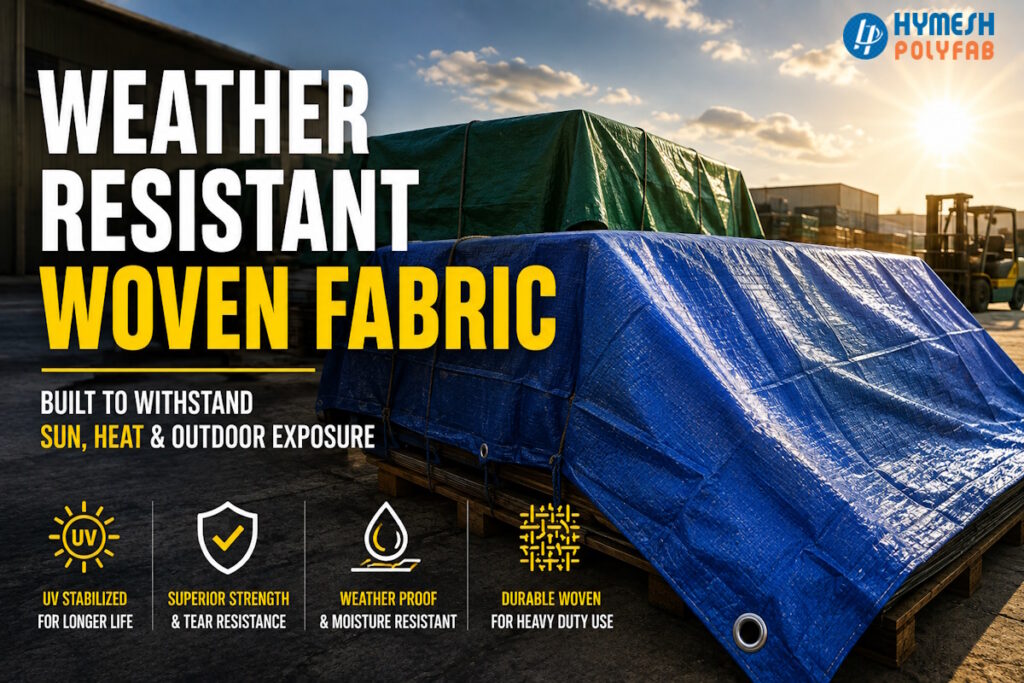
Procurement teams sourcing polymer textiles for open yards, transport fleets, and agricultural depots often face sudden material failures that appear without warning.
A batch of fabric may handle heavy tensile loads during factory testing, only to become brittle, discolored, and prone to tearing after eight to twelve weeks under continuous outdoor exposure.
When woven sheets crack or fray in the field, the underlying cargo, machinery, or aggregate loses its protective barrier, leading to moisture ingress, spoiled commodities, and costly insurance claims.
This breakdown rarely stems from an inadequate base polymer or poor weaving density alone. In most cases, premature failure happens because the purchasing specification failed to account for solar radiation, additive migration, and coating stability. Sourcing genuine weather resistant woven fabric requires moving beyond basic weight metrics and understanding how ultraviolet stabilization works at the polymer level. When buyers know how to evaluate chemical additives, tape extrusion parameters, and lamination chemistry, they can secure fabrics that maintain their physical strength under harsh environmental conditions.
Why Standard Polyolefin Fabrics Fail Under Direct Sunlight
Polypropylene (PP) and high-density polyethylene (HDPE) are naturally susceptible to solar radiation. When raw polyolefin polymers absorb ultraviolet wavelengths, specifically UV-A and UV-B bands present in terrestrial sunlight, a chemical process known as photo-oxidation begins. The high-energy solar photons excite the carbon-hydrogen bonds within the polymer backbone, producing free radicals. These unstable radicals react aggressively with atmospheric oxygen, initiating chain scission, where long polymer chains break into shorter, weaker segments.
At a physical level, this chemical degradation manifests in stages that industrial buyers can easily identify in field failures:
- Surface Chalking and Discoloration: The initial sign of photo-oxidation is a dull, powdery film on the fabric surface as the polymer chains fragment.
- Loss of Flexibility: As molecular cross-linking and chain breaks progress, the pliable woven tapes lose their elasticity and turn stiff.
- Micro-Cracking Across Weave Intersections: Stress points between warp and weft tapes develop fine fractures under wind flutter or mechanical load.
- Catastrophic Tensile Failure: Once structural integrity is compromised, the fabric shreds under light manual pressure or normal atmospheric wind resistance.
Unstabilized polyolefin tapes exposed to intense sunlight can lose up to 80 percent of their original tensile strength in fewer than three months. For heavy industrial use, relying on basic commodity grade plastics without specialized additives guarantees premature replacement and operational downtime. Selecting a properly formulated UV stabilized woven fabric prevents this progressive molecular collapse by neutralizing free radicals before they fracture the polymer matrix.
Core Technical Factors in Formulating Weather Resistant Woven Fabric
Transforming standard polymers into long-lasting outdoor materials requires targeted additive chemistry during the masterbatch extrusion stage. Fabric manufacturers incorporate light stabilizers into virgin resin pellets before drawing the polymer into flat tapes. The primary chemical class used for high-durability industrial fabrics is Hindered Amine Light Stabilizers, commonly referred to as HALS. Rather than simply absorbing UV energy, HALS compounds act as radical scavengers, repeatedly capturing free radicals and regenerating themselves through a cyclical chemical process.
However, an effective outdoor fabric requires balanced engineering across the entire cross-section of the material. A well-constructed HDPE fabric relies on several interconnected formulation variables:
- Masterbatch Purity and Dispersion: If the UV additive masterbatch is poorly dispersed in the extruder barrel, some tapes receive excessive stabilizer while adjacent tapes receive almost none. This uneven distribution causes localized weak spots where tearing initiates.
- Thermal and Processing Antioxidants: Extrusion temperatures can degrade UV stabilizers before the tapes are even woven. Formulators must include secondary antioxidants (phosphites and hindered phenols) to protect the resin melt during processing.
- Dual-Layer Stabilization: In coated fabrics, stabilizing only the woven scrim is insufficient. The outer extrusion lamination layer faces direct solar radiation first. If the coating lacks UV stabilizers, it will crack, peel, and delaminate, leaving the inner structural tapes exposed to environmental moisture.
- Pigment Interactions: Certain colorants accelerate degradation. Titanium dioxide (white) and carbon black (black) offer natural UV blocking capabilities, whereas certain red or yellow organic pigments can interact negatively with HALS, reducing their active service life.
Specifying a true UV resistant HDPE fabric means confirming that both the base structural tapes and the external protective coating have been formulated with compatible, synergistic stabilizer packages.
Need Outdoor Woven Fabric Specifications?
Evaluating GSM Versus UV Additive Loading
One of the most widespread procurement mistakes in industrial purchasing is equating fabric weight (GSM, or grams per square meter) directly with weather resistance. Procurement officers frequently assume that moving from a 120 GSM fabric to a 180 GSM fabric automatically yields longer outdoor durability. While a heavier fabric provides higher initial tensile strength, greater puncture resistance, and thicker tape profiles, thickness alone cannot stop photo-oxidation.
A 200 GSM un-stabilized fabric will degrade just as rapidly under aggressive solar exposure as a 90 GSM un-stabilized fabric. In fact, a lighter 110 GSM fabric formulated with high-quality HALS at the correct percentage will substantially outlast a heavier, un-stabilized alternative when deployed in open yards. GSM determines mechanical load-bearing capacity, tear thresholds, and abrasion resistance. UV additive loading determines chemical longevity and resistance to sunlight.
When engineering durable woven packaging or open-air coverings, buyers must decouple these two specifications. GSM should be determined by handling demands, wind loads, stacking stress, and transit friction. Once mechanical requirements establish the necessary weight, the UV stabilization level must be determined by geographical location, solar exposure duration, and expected operational lifespan. Treating fabric mass and polymer chemistry as independent specification pillars prevents unnecessary material costs and early field failures.
Industrial Applications Demanding High Weather Resistance
Different industrial operating environments place distinct combination stresses on polymer fabrics. Outdoor protective covers rarely face sunlight in isolation; they must endure simultaneous heat, moisture, abrasive particulate matter, and wind turbulence. Sourcing an appropriate outdoor storage fabric requires matching the structural profile to specific environmental conditions.
Agricultural Field Protection and Crop Storage
Agricultural bulk storage involves prolonged seasonal exposure in wide open fields where solar radiation is continuous. Grain covers, fodder tarpaulins, and temporary silage sheets must withstand high solar irradiance alongside biological moisture from underlying crops. Selecting a heavy-duty black hdpe tarpaulin provides deep opacity, high carbon black UV absorption, and uniform moisture protection across extended harvest cycles.
Construction Sites and Infrastructure Projects
Building sites represent harsh operating arenas where fabrics function as perimeter scaffolding screens, ground barriers, and machinery covers. Materials utilized as HDPE woven fabric in construction face abrasive contact with concrete dust, scaffolding hardware, and structural steel edges. Unstabilized materials weaken quickly under the sun, tearing loose under moderate gusts and creating job-site hazards.
Industrial Storage Yards and Port Terminals
Logistics operators managing open port facilities, rail sidings, and factory holding yards rely on durable outdoor woven fabric to protect crated machinery, metal coils, and raw minerals. Port environments add coastal salt spray and high atmospheric humidity to solar exposure. If the lamination coat degrades under sunlight, ocean air penetrates the packaging, accelerating internal rust and surface corrosion on high-value industrial assets.
Need Weatherproof Fabric for Outdoor Storage?
Common Procurement Pitfalls in Sourcing Outdoor Polyfabrics
When buyers purchase polyfabrics strictly based on low commercial bids, critical stabilization parameters are often compromised during manufacturing. Understanding common production shortcuts helps procurement teams spot vulnerable materials before issuing purchase orders.
- Relying on Calcium Carbonate Fillers: Low-cost fabric producers frequently blend high percentages of calcium carbonate (chalk masterbatch) into the resin to cut polymer costs. While minor amounts improve tape flatness, excessive filler weakens the polymer matrix, accelerates moisture absorption, and significantly impairs the protective action of UV stabilizers.
- Unstabilized Lamination Coatings: Some manufacturers add HALS to the woven base scrim to satisfy basic tensile testing criteria, but omit additives from the low-density polyethylene (LDPE) coating layer. Under sun exposure, the outer coating develops micro-fractures, destroying the barrier performance of the weatherproof HDPE fabric while the interior weave remains intact.
- Vague Purchase Orders: Simply writing “UV treated” on a purchase contract provides zero technical protection. Without specifying minimum retained tensile strength over time, geographical solar irradiance assumptions, or testing standards, buyers leave quality benchmarks open to interpretation.
- Using Reground or Recycled Scrap: Incorporating unverified post-consumer or degraded internal scrap introduces pre-oxidized polymer chains into the tape melt. These damaged chains accelerate free radical formation, degrading the performance of newly added stabilizers.
Industrial organizations looking to avoid these risks should work directly with established manufacturers who run controlled extrusion processes. Teams preparing large supply agreements can contact HDPE fabric supplier teams directly to review masterbatch sourcing, stabilization chemistry, and production control standards.
What Buyers Should Verify Before Ordering
To ensure consistent quality across large procurement contracts, purchasing teams must establish explicit technical standards with their fabric manufacturer. Finalizing an order should involve confirming operational conditions, material chemistry, and measurable performance thresholds rather than accepting general product descriptions.
Before issuing an approved specification sheet, verify these critical variables:
- Solar Exposure Location and Kly Rating: Solar radiation intensity is measured in kilo-Langleys (kly) per year. Outdoor exposure in northern Europe averages 80 to 100 kly, whereas central India, the Middle East, or Australia can exceed 160 to 200 kly. Clarify where the fabric will operate so the manufacturer can match additive concentration to real-world irradiance.
- Target Outdoor Lifespan: Clearly define whether the application requires temporary three-month protective shielding, a full seasonal deployment of six to twelve months, or multi-year structural performance.
- Retained Tensile Strength Criteria: Request a baseline retained strength specification, such as maintaining at least 50 to 70 percent of original grab tensile strength after an agreed exposure period or accelerated QUV weathering test cycle.
- Lamination Film Stabilization: Confirm that both the primary woven tapes and the secondary extrusion coating contain compatible, dedicated stabilizer packages.
- Virgin Resin Certification: Verify the proportion of virgin polyolefin resin versus clean internal regrind to ensure base polymer chain stability.
Addressing these parameters directly with Hymesh Polyfab ensures that your bulk woven fabric rolls or converted covers arrive with the exact chemical formulation, mechanical density, and environmental endurance your operations require.
Discuss Your Woven Fabric Requirements