
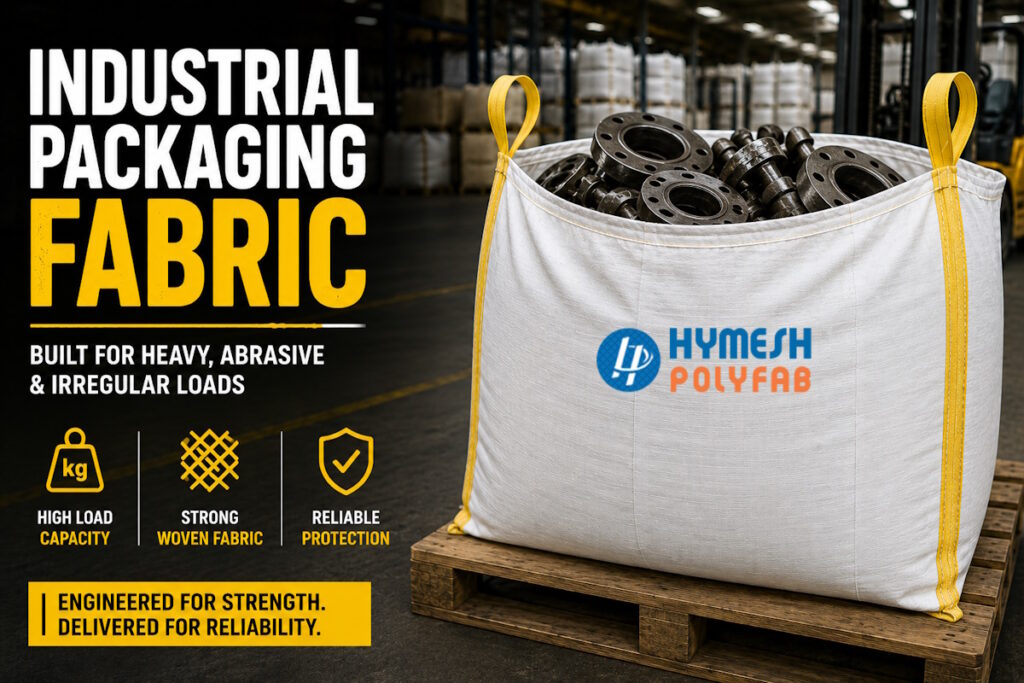
Packaging heavy industrial machinery parts, jagged metal scrap, coarse minerals, or irregularly shaped cast components presents severe physical challenges during storage and transport.
Standard packaging films and light duty materials frequently fail under point-load pressure, sharp protruding edges, and internal friction caused by transit vibration.
When containment fails, businesses face substantial product damage, safety hazards for handling personnel, and costly supply chain delays. Selecting the correct industrial packaging fabric requires a clear understanding of the mechanical forces exerted by the load.
Procurement teams and plant managers often struggle to balance fabric weight against practical durability. Simply increasing fabric weight does not automatically prevent punctures from sharp corners or abrasion wear from continuous shifting. Designing an effective packaging solution requires evaluating polymer selection, tape tensile properties, weave construction, and protective coatings. Sourcing from an experienced industrial woven fabric manufacturer in India allows industrial operations to tailor fabric parameters to exact physical stresses rather than relying on generic off-the-shelf wrapping materials.
Understanding Load Characteristics: Heavy, Abrasive, and Irregular Goods
Before selecting fabric specifications, buyers must categorize the exact physical behavior of their cargo. Different industrial materials exert distinct mechanical stresses on containment textiles during dynamic handling and long-distance transport.
Point Loads and Puncture Risks
Irregular items such as forged metal fittings, structural steel components, valves, and heavy machine parts concentrate immense pressure on tiny surface areas. Standard packaging textiles can rupture at these contact points when dropped, strapped, or stacked. To prevent point-load rupture, the fabric must exhibit high puncture resistance and balanced multidirectional tensile strength across both warp and weft tapes.
Continuous Internal and External Abrasion
Abrasive goods like raw minerals, aggregate, metal turnings, and coarse foundry sand create severe frictional wear. As transport vehicles experience road vibration or maritime roll, loose particles rub against the inner packaging surface. Over thousands of transit miles, this friction wears through unreinforced fabrics. An effective abrasion resistant woven fabric utilizes tight weave geometry and specialized resin formulations to withstand surface rubbing without fiber degradation.
Dynamic Shifting and Load Deformation
Heavy, dense cargo tends to shift during forklift maneuvers and transit stops. As the load shifts, immense lateral forces push against the packaging perimeter. If the textile lacks sufficient elongation recovery or seam strength, the structure stretches out of shape or bursts. Specifying a dependable bulk load packaging fabric ensures the material flexes slightly under shock loads while retaining structural containment.
Need Heavy-Duty Packaging Fabric?
Polymer Selection: HDPE vs. PP for Demanding Industrial Uses
Choosing between High-Density Polyethylene (HDPE) and Polypropylene (PP) forms the foundation of any textile packaging specification. While both polymers are workhorses of modern logistics, they possess distinct mechanical traits that perform differently under heavy industrial loads.
High-Density Polyethylene (HDPE) Fabrics
HDPE offers superior impact strength, high tear resistance, and outstanding flexibility in low-temperature environments. HDPE tapes are naturally more pliable and less prone to stress cracking under sharp point loads. This makes HDPE woven structures ideal for wrapping irregular metal parts, outdoor heavy equipment covers, and raw material transport where flexibility and tear resistance are critical.
Polypropylene (PP) Fabrics
Polypropylene delivers higher tensile strength, greater surface stiffness, and superior resistance to flex fatigue compared to HDPE at equivalent weights. PP is the industry standard for intermediate bulk containers, heavy duty bags, and rigid wrapping systems. However, PP can become brittle under extreme sub-zero temperatures. Industrial buyers regularly specify PP when load rigidity and dimensional stability under high stacking loads are top priorities.
For operations seeking optimized industrial packaging materials, the choice often comes down to dynamic impact demands versus vertical stacking stiffness. In specific demanding applications, blended formulations or co-extruded structures may be utilized to capture the benefits of both polymers.
Key Technical Parameters to Specify for Abrasive and Heavy Loads
A comprehensive procurement specification goes far beyond simply asking for a heavy fabric. Industrial procurement teams should systematically define several interrelated mechanical properties to ensure failure-free performance.
GSM and Tape Construction
Grams per Square Meter (GSM) indicates the weight of the fabric, but weave construction determines how that weight functions. A fabric with a GSM of 160 can perform very differently depending on tape width, tape thickness, and mesh count. For heavy loads, buyers should specify a dense mesh count (such as 10×10, 12×12, or 14×14 tapes per inch) using high-denier tapes to minimize gaps between yarns where punctures typically initiate.
Tensile Strength and Elongation Balance
A reliable high strength packaging fabric must balance breaking strength with appropriate elongation. If a fabric is overly rigid with near-zero elongation, sudden shock loads from forklift drops can cause immediate fiber rupture. An elongation factor between 15% and 25% allows the fabric to absorb kinetic energy and redistribute point stress across adjacent tapes before tearing occurs.
Lamination and Surface Coating Quality
Extrusion lamination applies a thin layer of molten LDPE or PP resin over the woven fabric base. Lamination plays several vital roles for abrasive cargo:
- Tape Locking: Lamination locks the warp and weft tapes in place, preventing yarn displacement when sharp edges push against the weave.
- Abrasion Barrier: A smooth inner lamination layer prevents coarse, abrasive bulk materials from catching on individual woven strands.
- Moisture and Dust Containment: Laminated woven fabric for industrial packaging creates an impermeable barrier against external humidity and prevents internal fine powders from leaking.
Need the Right Lamination Specification?
Preventing Failure Modes in Industrial Packaging Systems
Analyzing common containment failures reveals why generic fabrics fall short when wrapping heavy, irregular, or abrasive products. Understanding these structural breakdown mechanisms allows packaging engineers to design preventive specifications.
Tear Propagation and Edge Snagging
When an irregular item creates a small nick or puncture in standard packaging, dynamic vibrations during transport cause that small hole to run along the weave line, leading to catastrophic splitting. Specifying high-tenacity virgin polymer tapes and optimized tape overlap stops tears from propagating beyond the initial point of contact. Using multi-layered or reinforced Woven Poly Fabric significantly reduces the likelihood of transit punctures developing into total load failure.
Delamination Under Heavy Friction
Inferior lamination processes often fail when subjected to continuous surface shear from abrasive loads. If the bonding between the base woven fabric and the extruded coating film is weak, the film peels away, exposing the structural tapes to rapid abrasive destruction. Buyers should verify coating adhesion standards and ensure the extrusion process uses quality virgin bonding resins.
Environmental Degradation During Outdoor Staging
Heavy machinery parts, structural steel bundles, and industrial minerals are frequently staged in open yard storage prior to shipment. Sunlight quickly degrades unprotected polymers through photo-oxidation. When untreated industrial woven fabric is exposed to intense solar radiation, tensile strength drops rapidly, causing containment to fail during subsequent lifting. Specifying proper UV stabilization packages ensures the fabric maintains structural integrity throughout required storage windows.
Optimizing Bulk Containment for Complex Industrial Applications
Different industrial sectors encounter distinct packaging hurdles that require customized textile solutions. Matching the fabric design to the exact supply chain route ensures cost-efficient protection.
Metal Fabrication, Castings, and Machined Components
Forged automotive components, steel bars, and cast machine housings are heavy, irregularly shaped, and coated in protective oils. For these applications, fabric must offer high puncture resistance, oil compatibility, and grease containment. Double-side laminated fabric prevents internal lubricants from leaking while keeping exterior dust and moisture out.
Mining, Minerals, and Refractory Raw Materials
High-density minerals and chemical aggregates exert extreme continuous abrasive forces. When selecting bulk packaging material for these commodities, focus on thick base tape constructions paired with heavy micron lamination layers. This combination prevents fine mineral particles from grinding through load-bearing yarns during rail or truck transit.
Export Logistics and Multi-Modal Transit
Export packaging faces container condensation, ocean humidity, rough crane handling, and extensive transit times. Export fabrics require balanced warp and weft strength, robust UV inhibitors, and precision lamination to protect valuable industrial cargo from saltwater atmosphere, temperature fluctuations, and heavy stacking pressures inside ship holds.
Discuss Your Woven Fabric Requirements
What to Confirm Before Placing a Bulk Order
Specifying industrial packaging fabric requires clear communication between your technical procurement team and the manufacturing mill. Providing detailed operational parameters avoids costly over-specification or dangerous under-engineering.
Before placing a bulk order, compile and verify the following technical parameters with your supplier:
- Cargo Profile: Exact product weight, shape irregularity, presence of sharp edges, oil content, and particle abrasiveness.
- Base Polymer: Selection of virgin HDPE or PP resin based on temperature requirements, flexibility, and load rigidity needs.
- Target GSM and Construction: Defined base fabric GSM, tape width, denier, and mesh count per square inch.
- Coating Specifications: Unlaminated, single-side laminated, or double-side laminated, including the exact coating thickness in microns or GSM.
- Environmental Protection: UV stabilization levels based on expected outdoor yard exposure time and local sunlight intensity.
- Roll Dimensions and Converting Needs: Roll width, roll length, core diameter, or specific cut-piece sizes required for automated or manual wrapping lines.
When you are ready to evaluate technical samples or establish a reliable manufacturing partnership, you can contact woven fabric supplier teams at Hymesh Polyfab to discuss tailored specifications engineered for your exact industrial load requirements.