
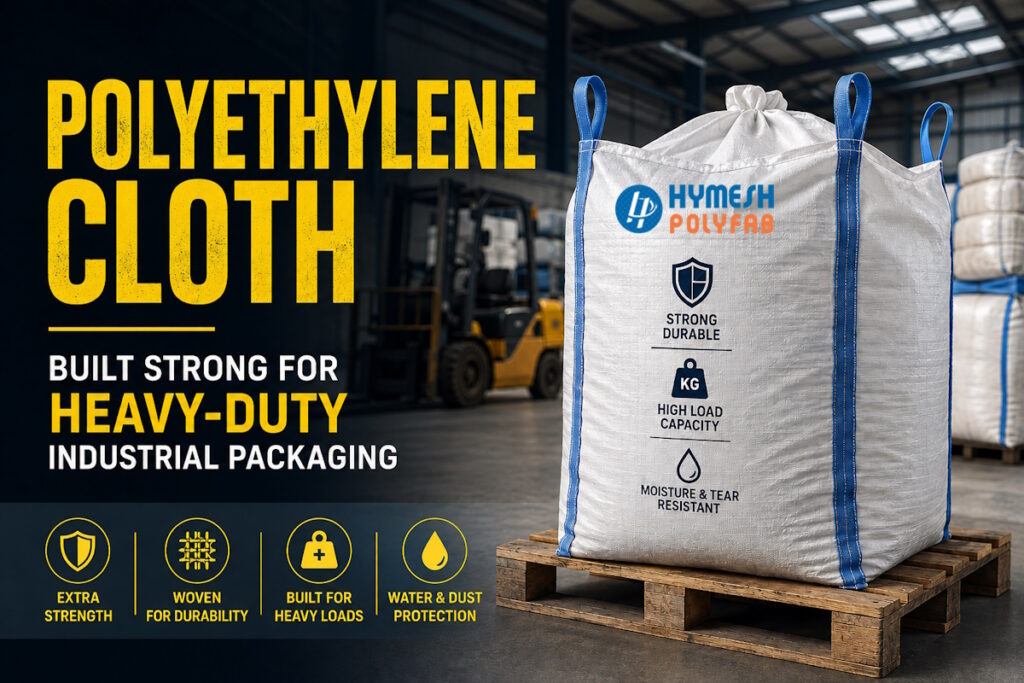
Industrial packaging has a very different job from normal retail packaging.
It must protect heavy products, handle rough movement, survive changing weather, and stay strong during storage and transport.
Materials used for industrial packaging must also be practical, cost-effective, and easy to handle.
This is where polyethylene cloth plays an important role.
Polyethylene cloth is widely used in industrial packaging because it combines strength, flexibility, moisture resistance, and long service life. It can be used for bags, covers, wrapping sheets, container liners, protective packaging, and many other industrial applications. Depending on how it is made, polyethylene cloth can be available in different forms to meet specific industrial packaging needs.
For companies that need a reliable bulk packaging material, polyethylene-based fabrics offer several useful benefits. They can protect products during transport while keeping packaging weight and cost under control.
Need the right polyethylene cloth for your industrial packaging needs?
What Is Polyethylene Cloth?
Polyethylene cloth is a strong fabric made from polyethylene, one of the most commonly used plastic materials in the world. The material can be turned into thin tapes or strips, which are then woven together to create a strong and flexible fabric.
When polyethylene strips are woven in this way, the finished material is often known as polyethylene woven fabric. High-density polyethylene is commonly used for making these woven materials because of its strength and durability. This type is known as HDPE woven fabric.
The woven structure gives the material high strength without making it too heavy. Manufacturers can also add a protective coating or laminate to the woven base. The result is laminated woven fabric, which provides extra protection against water, dust, and other outside conditions.
These different forms allow polyethylene cloth to meet a wide range of industrial packaging needs.
High Strength for Heavy-Duty Applications
One of the main reasons polyethylene cloth is used in industrial packaging is its high strength.
Industrial goods can be heavy, sharp, rough, or difficult to handle. Packaging materials often face pulling, lifting, stacking, and movement during transportation. Weak packaging may tear or break under these conditions.
Polyethylene woven materials are designed to handle much more stress.
The woven structure spreads force across many strips of material instead of placing all the pressure on one point. This improves tear resistance and helps prevent sudden packaging failure.
Because of this property, HDPE woven fabric is commonly used for packaging products such as fertilizers, grains, chemicals, construction materials, minerals, agricultural products, and industrial components.
A strong packaging material can also reduce product loss. When packaging stays secure, businesses have a lower risk of spills, damage, or contamination during shipping.
Excellent Resistance to Moisture
Moisture is one of the biggest concerns in industrial packaging.
Many products can lose quality when exposed to rain, humidity, or water. Powders may form lumps, grains may become damaged, chemicals may react with moisture, and building materials may lose their original quality.
Polyethylene cloth naturally provides good resistance to water. For applications where stronger moisture protection is required, manufacturers can use coated or laminated materials.
A laminated woven fabric usually has an additional polyethylene layer placed over the woven base. This helps close the small spaces between the woven tapes and creates a stronger barrier against moisture.
This feature makes laminated polyethylene fabrics useful for outdoor storage and long-distance transport.
For example, industrial products may remain at ports, warehouses, construction sites, or open storage areas for several days. Packaging made from moisture-resistant materials gives the contents better protection during these conditions.
Lightweight but Strong
Heavy-duty packaging needs to be strong, but it should not add too much unnecessary weight.
This is another major advantage of polyethylene woven fabric.
The material has an excellent strength-to-weight balance. It can carry or protect heavy products while remaining much lighter than many traditional packaging materials.
Lower packaging weight offers several practical benefits.
Businesses may reduce overall shipping weight. Workers can handle empty bags or covers more easily. Large amounts of packaging material can also be stored in a smaller space.
For companies handling thousands of packages every day, even a small reduction in packaging weight can make a noticeable difference in transport and handling costs.
This combination of low weight and high strength makes polyethylene cloth an effective bulk packaging material.
Good Tear and Puncture Resistance
Industrial packaging often comes into contact with rough surfaces, sharp corners, machinery, pallets, and other packages.
During loading and unloading, packaging can be dragged, pressed, dropped, or stacked. A small puncture can quickly become a large tear if the material is not strong enough.
HDPE woven fabric offers good resistance to tearing because of its woven construction. If stress affects one section of the material, the woven tapes help spread that stress over a wider area.
The fabric can also be made in different thicknesses and weaving patterns depending on the level of protection required.
For products with harder surfaces or demanding transport conditions, thicker woven materials can provide extra security.
This makes polyethylene-based packaging suitable for both normal industrial use and more demanding heavy-duty applications.
Suitable for Bulk Packaging
Many industries need to pack products in large quantities rather than small consumer packs.
Agriculture, construction, mining, chemical production, food processing, and manufacturing often deal with hundreds or thousands of kilograms of material at a time.
Packaging for these industries must carry large loads safely.
Polyethylene fabric works well as a bulk packaging material because it can be used for large woven sacks, flexible intermediate bulk containers, liners, wrapping materials, and protective covers.
The fabric can be designed according to the size and weight of the product.
Manufacturers can also add handles, lifting loops, liners, closures, printing, or extra layers when needed. This allows industrial companies to choose packaging based on their exact handling and storage process.
Need help choosing between HDPE woven fabric and laminated woven fabric?
Protection Against Dust and Dirt
Industrial products are often stored or transported through places where dust and dirt are common.
Warehouses, ports, factories, farms, and construction areas can expose goods to many outside materials. Packaging should help keep these materials away from the product.
Standard polyethylene woven fabric provides basic protection, while laminated versions can offer a more complete barrier.
A laminated woven fabric has a smoother and more closed surface than normal woven fabric. This helps prevent fine dust and dirt from passing through the packaging.
This can be especially useful when packaging powders, food ingredients, agricultural goods, chemicals, or other products that need cleaner storage conditions.
Flexible and Easy to Handle
Strength alone does not make a packaging material useful. It must also be easy to work with.
Polyethylene cloth is flexible enough to be folded, cut, stitched, shaped, and converted into different packaging forms.
This flexibility makes it easier for packaging manufacturers to produce bags and covers in many sizes.
Workers can also handle flexible packaging more easily during filling, loading, and unloading. When empty, woven bags and covers can often be folded flat, which reduces the storage space required.
Rigid containers can take up the same amount of space even when they are empty. Flexible polyethylene packaging, on the other hand, can usually be packed or stacked more efficiently.
This can be an important advantage for companies managing large packaging inventories.
Suitable for Outdoor Storage
Some industrial products spend a large amount of time outdoors.
Construction materials, agricultural goods, equipment, machinery, raw materials, and bulk products may remain exposed to sunlight, rain, dust, and changing temperatures.
Properly designed polyethylene cloth can provide useful protection in these environments.
Manufacturers can add UV stabilizers to polyethylene materials to improve resistance to sunlight. This can help reduce damage caused by long periods of outdoor exposure.
When combined with lamination, the fabric can also provide better protection against water and dirt.
The exact level of outdoor protection depends on the material quality, thickness, coating, additives, and length of exposure. For this reason, industrial users should select packaging based on their storage conditions.
Laminated Woven Fabric Provides Extra Protection
While normal woven polyethylene offers good strength, some products need a higher level of protection.
This is where laminated woven fabric becomes useful.
Lamination adds an extra layer to the woven material. This layer can improve water resistance, reduce the movement of dust through the fabric, and create a smoother surface.
Laminated fabrics may also provide better printing results. Companies can add product details, safety instructions, brand information, handling guidance, or other important information directly to the packaging.
This can help businesses combine product protection with clear identification.
Laminated materials are often selected when the contents are sensitive to moisture or when packaging may face difficult transport and storage conditions.
Useful Across Many Industries
Another reason for the popularity of polyethylene cloth is its wide range of uses.
The same basic material can be adjusted for very different products and industries.
In agriculture, polyethylene woven bags can be used for grains, seeds, animal feed, fertilizers, and other farm products.
In construction, HDPE woven fabric can be used for packaging sand, cement-related materials, minerals, and other building products.
Chemical companies may use woven or laminated sacks for dry chemical materials and industrial powders.
Manufacturers may use polyethylene covers or sheets to protect machinery, components, and finished goods during transport.
Food-related industries can also use suitable grades of woven packaging for products such as rice, flour, sugar, and other dry materials, provided the packaging meets the required food-contact standards.
This wide range of applications makes polyethylene cloth a practical choice for industrial packaging suppliers and users.
Cost-Effective for Large Packaging Operations
Packaging cost becomes very important when a company uses thousands or millions of bags, covers, or sheets every year.
A material may perform well, but it must also make financial sense.
Polyethylene woven materials can offer a good balance between price, weight, and performance. Their durability may help reduce packaging failure and product loss.
Their low weight may also help lower transport costs compared with heavier packaging choices.
Because the material can be produced in large quantities, it is suitable for businesses that need a steady supply of bulk packaging material.
The final cost depends on fabric weight, size, coating, printing, lamination, design, and other requirements. However, polyethylene woven packaging is often selected because it provides strong performance at a practical cost.
Customization for Different Packaging Needs
Industrial products do not all need the same type of packaging.
Some need moisture protection. Others need greater load strength. Some products require ventilation, while others must remain protected from dust.
Polyethylene fabrics can be customized to meet these different needs.
The manufacturer can adjust fabric weight, tape thickness, weave density, dimensions, coating, lamination, color, printing, and other features.
A business may choose standard polyethylene woven fabric when airflow is acceptable and basic protection is enough.
For products that require better moisture resistance, laminated woven fabric may be more suitable.
For demanding loads, a stronger grade of HDPE woven fabric may be selected.
This ability to customize the material helps companies avoid using more packaging than necessary while still giving their products the protection they need.
Easy Branding and Product Identification
Industrial packaging also carries important information.
A bag may need to display the product name, weight, manufacturer details, safety instructions, handling symbols, batch information, or branding.
Polyethylene woven materials can be printed in different ways depending on the fabric surface and packaging design.
Laminated fabrics often provide a smoother printing surface and can support clearer graphics.
Good printing makes products easier to identify in warehouses and during transportation. It can also help reduce handling mistakes.
For businesses selling packaged products to distributors or other companies, attractive and clear packaging can also support brand recognition.
Can Support Reuse in Suitable Applications
In some applications, strong polyethylene packaging may be used more than once if it remains clean, undamaged, and suitable for the intended purpose.
The strength of HDPE woven fabric can make reuse possible in certain transport and storage situations.
However, reuse depends on the product being packed, the condition of the packaging, safety requirements, and local regulations.
Packaging used for chemicals or contaminated materials, for example, may not be suitable for another purpose.
Companies should always inspect packaging before reuse and follow the correct safety and quality rules.
Factors to Consider When Choosing Polyethylene Cloth
Although polyethylene fabric is suitable for many industrial packaging applications, businesses should select the correct grade carefully.
The first factor is load capacity. Packaging should be strong enough for the weight of the product.
The second factor is moisture exposure. Products stored outdoors or transported through wet conditions may require laminated material.
The third factor is the type of product. Fine powders may need a tighter structure or inner liner, while some agricultural products may require more airflow.
Businesses should also consider UV exposure, storage duration, transport distance, handling method, printing needs, and local packaging standards.
Choosing the right material is not simply about selecting the thickest fabric. The goal is to find the correct balance of strength, protection, weight, and cost.
Why Polyethylene Cloth Is a Practical Industrial Packaging Choice
Heavy-duty industrial packaging must perform under pressure. It needs to protect products during filling, handling, stacking, storage, and transportation.
Polyethylene cloth meets many of these needs in one practical material.
Its woven structure provides strength and tear resistance. Its low weight makes handling easier. Its natural moisture resistance helps protect goods, while lamination can provide an even stronger barrier against water and dust.
Different forms, including polyethylene woven fabric, HDPE woven fabric, and lamated woven fabric, give manufacturers and industrial users several options based on their packaging requirements.
The material can also be produced in different sizes, weights, colors, and designs, making it suitable for many industries.
Conclusion
Industrial packaging has to do much more than simply hold a product. It must keep goods safe through demanding storage, transport, and handling conditions.
That is why polyethylene cloth has become an important material for heavy-duty packaging.
It offers a useful combination of strength, flexibility, low weight, moisture resistance, tear resistance, and customization. These qualities make it suitable for everything from sacks and covers to liners and large-capacity packaging.
Polyethylene woven fabric provides the strength needed for demanding industrial use, while HDPE woven fabric offers durable performance for heavy loads. When additional protection against water, dust, or outside conditions is required, laminated woven fabric can provide an added protective layer.
For businesses looking for a dependable bulk packaging material, polyethylene-based woven fabrics can offer a practical balance between protection, handling, and cost. With the right fabric type and construction, they can help keep industrial products safer from the factory floor to their final destination.
Ready to choose the right polyethylene cloth for your industrial packaging application?