
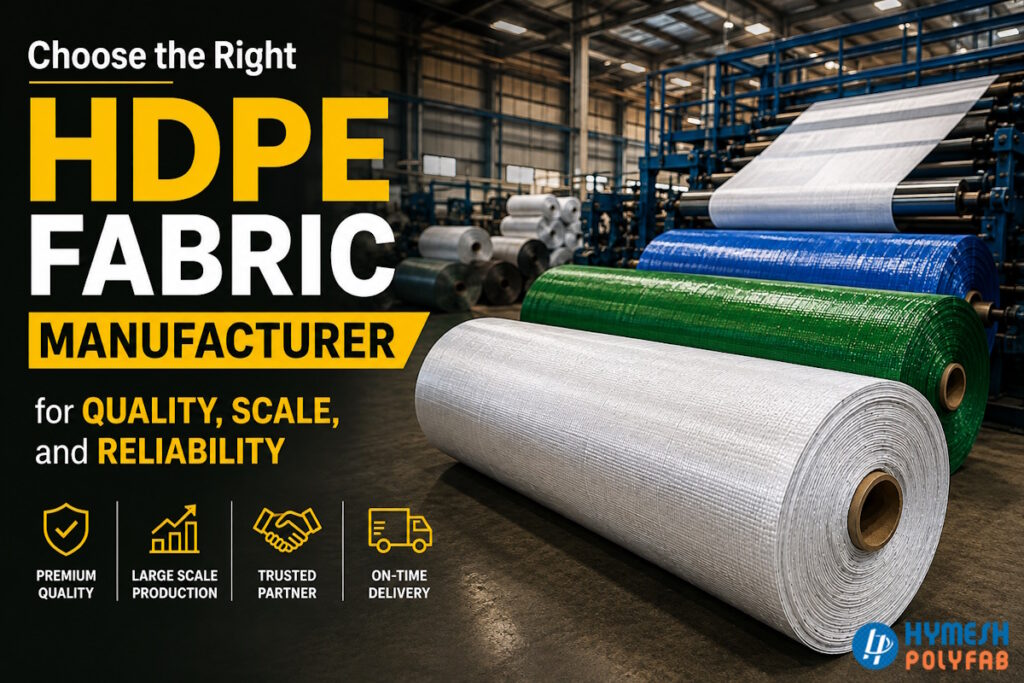
Buying high density polyethylene fabric may seem simple at first. You find a manufacturer, check the price, choose the required size, and place an order. In practice, there is a little more to consider.
The quality of the fabric, type of raw material, production capacity, roll size, customization options, and delivery schedule can all affect your purchase.
These points become even more important when you are buying material regularly or placing a large order.
India has many manufacturers and suppliers of HDPE woven products. This gives buyers plenty of choices, but it can also make comparison difficult. One supplier may offer a lower price, while another may provide better customization or more consistent quality. A manufacturer that works well for small orders may not always be suitable for businesses that need bulk HDPE fabric every month.
So, how do you narrow down your options? It starts with knowing what you actually need and asking manufacturers the right questions.
Looking for high density polyethylene fabric for your business?
Start With Your Actual Fabric Requirement
Before asking for prices, write down your basic requirements. This simple step can save a lot of time later.
Think about where the fabric will be used. Is it for agriculture, packaging, construction, storage, transport, or another industrial purpose? The application will usually determine the type of fabric you need.
You should also consider the width, roll length, weight, color, weave, strength, and coating. If you already use an HDPE fabric roll, check its current specifications before approaching a new manufacturer. This gives the supplier something clear to work with.
Quantity matters too. There is a big difference between buying a few rolls for occasional use and purchasing several tons of material on a regular basis.
When manufacturers receive clear details, they can suggest a suitable product and provide a more useful quotation.
Pay Attention to the Raw Material
Two HDPE fabrics can look similar but perform differently in actual use. Raw material is one reason for this difference.
Ask the manufacturer what type of material goes into the fabric and whether different material options are available. The right choice will depend on what you plan to do with the finished product.
Outdoor applications deserve extra attention. If the fabric will spend long periods in sunlight or changing weather, discuss this with the manufacturer before ordering. Do not assume every product offers the same level of outdoor performance.
Price is important, but buying only on price can be risky. A cheaper product is not really cheaper if it needs frequent replacement or creates problems during use.
Can the Manufacturer Handle Your Order Volume?
This question is easy to overlook, especially when the first sample looks good.
A manufacturer may be able to produce excellent material in small quantities but still struggle with a large order. If you need regular supplies, find out whether the factory has enough production capacity to support your business.
Ask about typical monthly production, normal lead times, and how the company manages repeat orders. For a large bulk HDPE fabric requirement, you can also discuss how far in advance the manufacturer needs your order.
This becomes particularly important when the material is part of your own production process. A late shipment can hold up other work and create unnecessary costs.
Your supplier should be able to handle today’s requirement while also having enough capacity to support you if your order volume increases.
Do Not Skip Quality Checks
Consistency matters just as much as the quality of the first roll.
When buying HDPE woven fabric, ask how quality is checked during production. Depending on the product, the manufacturer may inspect width, weight, weave, strength, roll length, finish, and other details.
The important point is not simply whether the company says it performs quality checks. Try to understand what it actually checks and at which stages.
For example, if roll length is important to your operation, make sure this is clearly agreed before production. The same applies to width, weight, color, and other specifications that can affect your work.
It is much easier to agree on these points before an order than to solve a problem after the material has arrived.
Ask for a Sample Before a Large Purchase
A sample gives you something real to inspect.
Check the weave, finish, thickness, flexibility, and overall appearance. If possible, use the sample in the same conditions where the final product will be used.
Suppose the fabric is going to be pulled, folded, covered, stitched, or handled frequently. A simple practical test can tell you much more than looking at a product photo.
For a custom product, try to request a sample that is close to your planned specification. A standard sample may show general manufacturing quality, but it may not represent the exact material you eventually order.
Samples are particularly useful when you are comparing two or three manufacturers that appear similar on paper.
Check Whether Custom Sizes Are Available
Standard products work for many buyers, but not every application has standard requirements.
A good woven fabric supplier should be able to explain which widths, roll lengths, weights, colors, coatings, and finishes are available. If you require a custom product, ask about it early in the discussion.
Custom sizing can sometimes reduce waste. For example, if you regularly cut a wider roll down to a smaller size, purchasing material closer to your required width may make the process more efficient.
However, customized production may come with a different minimum order quantity or lead time. Make sure you understand these conditions before finalizing your specifications.
Already know the size or quantity you need?
Compare More Than the Price Per Roll
Price naturally matters when choosing a manufacturer. For large orders, even a small difference can affect the final purchasing cost.
Still, quotations need to be compared carefully.
Check whether you are actually comparing the same product. One quotation may be based on a different fabric weight, width, roll length, raw material, finish, or packing method.
Also ask what is included in the quoted price. Transport, taxes, packing, custom production, and other charges can change the final amount you pay.
With bulk HDPE fabric, quality differences can also have a financial impact. Saving a small amount on the purchase price may not help if inconsistent material leads to extra waste or replacement costs.
Look at the complete value of the order rather than one number on the quotation.
Ask About the Minimum Order Quantity
Minimum order quantity, or MOQ, can vary from one manufacturer to another.
It may also change depending on the fabric width, color, weight, coating, or customization you select.
If you are testing a new supplier, a very high MOQ may not be convenient. You may prefer to start with a smaller quantity and see how the material performs before committing to a larger purchase.
For regular high-volume buyers, the situation is different. A manufacturer focused on larger production runs may be able to offer better planning and pricing for repeat orders.
There is no single ideal MOQ. The right one is simply the one that fits the way your business purchases material.
Delivery Can Be as Important as Production
Good fabric arriving late can still cause problems.
Before confirming an order, ask for a realistic production and dispatch timeline. If you have a fixed date by which the material must arrive, tell the manufacturer from the beginning.
Transport time also needs to be considered. An HDPE fabric roll moving from one part of India to another may take additional time after it leaves the factory.
Export buyers have a few more points to check. It helps to work with a manufacturer that understands export packing, shipping documents, container loading, and other basic export requirements.
If you plan to order regularly, ask how repeat deliveries are normally scheduled. A predictable supply arrangement can make stock planning much easier.
Notice How the Supplier Communicates
You can learn quite a lot about a company before placing an order simply by paying attention to its communication.
Does the supplier answer questions clearly? Are specifications written down properly? Does the quotation explain what you are getting? Can the team give you a realistic production timeline?
These things may seem small, but they matter when thousands of metres of fabric are being produced.
Clear communication is especially useful for custom orders. A small misunderstanding about width, weight, color, or roll length can become a much bigger issue once full production has started.
You do not need constant updates from a supplier. You do need clear answers when something important needs to be confirmed.
Industry Experience Can Make the Process Easier
A manufacturer does not necessarily need decades of experience in your exact industry. Still, experience with similar applications can be useful.
Agriculture, construction, packaging, storage, and transport do not always use HDPE fabric in the same way. A supplier familiar with your application may understand common requirements and questions more quickly.
Ask whether the manufacturer has supplied similar HDPE woven fabric before. You can also explain how you plan to use the material and see what specifications the supplier suggests.
This conversation can be useful even when you already know what you want. It gives you an idea of how well the manufacturer understands the product it sells.
Check the Company Behind the Product
If you are considering a long-term supplier, take some time to check the business itself.
Find out where the manufacturing unit is located and how long the company has been operating. For larger purchases, you may also want to ask for relevant product documents, test reports, certifications, or business details.
If the order value is high enough, a factory visit may be worthwhile. Seeing the production floor can help you understand how the material is made, stored, checked, and packed.
This level of checking may not be needed for every purchase. For a long-term supply agreement, though, it can provide useful confidence before you increase order volumes.
Consider a Trial Order
A product sample tells you about the fabric. A trial order tells you more about the supplier.
With a smaller first order, you can see whether the manufacturer follows the agreed specifications, packs the material properly, communicates clearly, and dispatches on time.
When the order arrives, inspect more than one roll. Compare the material with the specifications you agreed upon and note any differences.
If everything goes smoothly, you can move towards larger orders with greater confidence.
This approach can be particularly useful before committing to a large bulk HDPE fabric purchase.
Think Beyond the First Order
If HDPE fabric is something your company buys regularly, choosing a supplier should not be treated as a one-time price comparison.
A dependable supplier gradually learns your regular widths, weights, colors, packing preferences, order quantities, and delivery schedule. That can make future orders easier for both sides.
Consistency becomes more valuable as purchasing volume increases. You want the next batch to match the previous one without having to start the entire discussion again.
For this reason, consider whether the woven fabric supplier you choose can support your business over the longer term. Price still matters, but so do production capacity, communication, consistent quality, and reliable supply.
Questions Worth Asking Before You Order
Before making your final choice, have a direct conversation with the manufacturer.
Ask which types of high density polyethylene fabric are available and whether your required size can be produced. Confirm the MOQ, expected lead time, packing method, payment terms, and delivery arrangements.
For large or repeat orders, ask how the manufacturer maintains consistency between production batches. If you need customization, confirm those details in writing before production starts.
It is also worth asking about samples and trial orders if this is your first time working with the company.
A few clear questions at the beginning can prevent many problems later.
Conclusion
Choosing a high density polyethylene fabric manufacturer in India is not only about finding the lowest quotation. You are choosing the company that will be responsible for producing material your business may depend on every day.
Start with a clear understanding of your application and required specifications. Check the material quality, production capacity, customization options, MOQ, delivery schedule, and quality control process. Ask for a sample where possible, and consider a trial order before committing to a much larger quantity.
Whether you need a regular HDPE fabric roll, customized HDPE woven fabric, or ongoing bulk HDPE fabric supply, consistency should be one of your main priorities.
The right manufacturer should be able to answer your questions clearly, produce according to the agreed specifications, and supply the material when you need it. Finding that combination can save time, reduce purchasing problems, and make future orders much easier.
Planning your next high density polyethylene fabric order?