
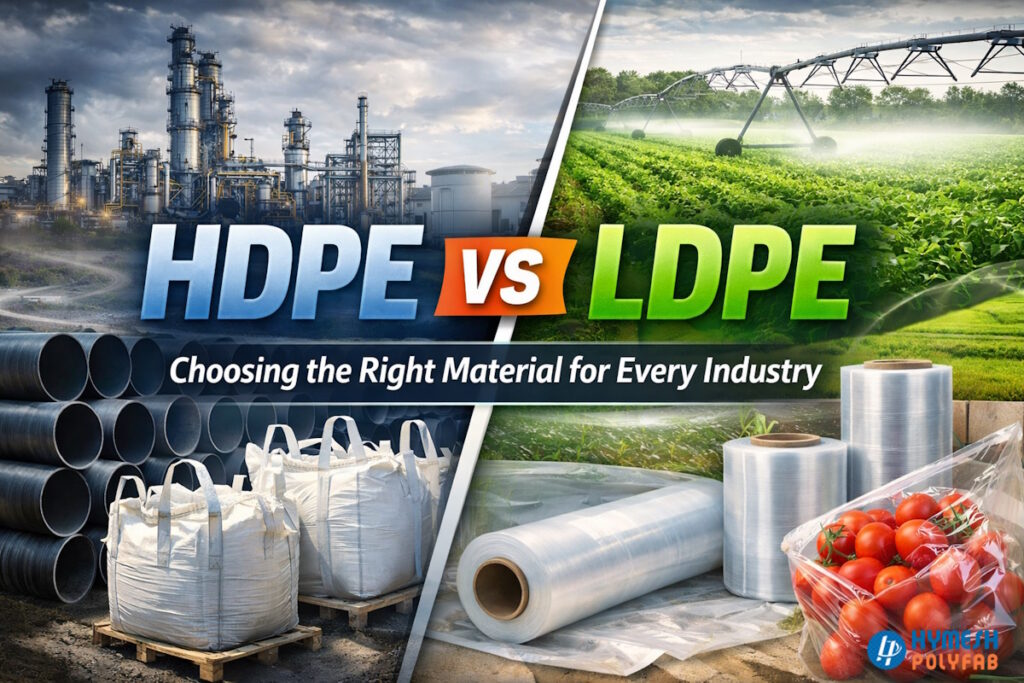
In the world of polymer engineering and industrial supply, selecting the right material is rarely a matter of simple preference.
For procurement managers, engineers, and agricultural exporters, the decision between High-Density Polyethylene and Low-Density Polyethylene can dictate the success or failure of a project.
While both materials originate from the same ethylene monomer, their molecular structures create vastly different performance profiles.
Understanding the hdpe and ldpe difference is essential when specifying woven fabrics, geomembranes, or protective liners, as the wrong choice often leads to material fatigue, environmental stress cracking, or unnecessary expenditure.
The distinction between these two polymers lies primarily in their branching. HDPE is characterized by a linear structure with minimal branching, allowing molecules to pack together tightly. This results in a dense, rigid material with high tensile strength. Conversely, LDPE features significant long-chain and short-chain branching, which prevents the molecules from packing closely. This lack of density makes LDPE more flexible and ductile, though it sacrifices some of the mechanical strength found in its high-density counterpart. For industrial buyers, these molecular differences translate into practical concerns regarding load-bearing capacity, chemical resistance, and weatherability.
Not sure whether HDPE or LDPE is right for your application?
Molecular Structure and Density Characteristics
The fundamental hdpe and ldpe difference begins at the polymerization level. When ethylene is processed under high pressure, it typically results in LDPE. When processed at lower pressures with specific catalysts, it produces HDPE. This chemical variance is the root of every physical characteristic that follows, from opacity to impact resistance. For industrial applications, density is not just a weight metric; it is a predictor of how the material will behave under stress and environmental exposure.
High-Density Polyethylene (HDPE) Properties
HDPE generally has a density range of 0.941 to 0.967 g/cm3. Due to its linear structure, it possesses a high degree of crystallinity, which makes the plastic more opaque and significantly harder than LDPE. It offers a higher strength-to-density ratio, meaning an HDPE woven fabric can support more weight than an LDPE film of similar thickness. This rigidity makes it the preferred choice for applications where structural integrity is non-negotiable.
Low-Density Polyethylene (LDPE) Properties
LDPE typically falls within a density range of 0.910 to 0.940 g/cm3. Because the molecular chains are branched, the material is more translucent and much more flexible. It has a lower melting point, which makes it excellent for heat-sealing applications. While it lacks the high tensile strength of HDPE, it excels in impact energy absorption and ductility, meaning it can stretch significantly before it breaks or tears.
Crystallinity and Its Impact on Opacity
The high crystallinity of HDPE makes it naturally milky or white in appearance. This reflects light and provides a better barrier against UV rays compared to the more transparent LDPE. In industrial settings, this opacity can be a benefit for protecting light-sensitive contents in packaging or agriculture.
The HDPE and LDPE Difference in Industrial Packaging
Packaging is perhaps the most visible arena where the hdpe and ldpe difference is put to the test. In heavy-duty industrial packaging, the choice of polymer affects everything from stackability in a warehouse to the integrity of the product during sea freight. Manufacturers must balance the need for puncture resistance with the need for moisture protection, often leading to a combination of both materials in a single product.
Woven Fabrics and Bulk Containers
Most heavy-duty woven sacks and FIBCs (Flexible Intermediate Bulk Containers) are manufactured using HDPE tapes. The reason is simple: HDPE provides the necessary tensile strength to hold hundreds of kilograms of material, such as cement, fertilizer, or grains, without stretching excessively. An LDPE woven sack would likely deform under the same weight, leading to stability issues during transport. The rigidity of HDPE ensures that stacked bags maintain their shape and do not lean or collapse in storage.
Liners and Moisture Protection
While HDPE provides the strength, LDPE is frequently used as a liner or a lamination layer. Because LDPE is more flexible and has superior moisture barrier properties in thin-film form, it is ideal for protecting sensitive powders from humidity. We often see industrial buyers requesting HDPE woven fabric that is laminated with a thin layer of LDPE. This hybrid approach utilizes the strength of the HDPE base and the waterproofing capabilities of the LDPE coating.
Heat Sealing and Closure Integrity
LDPE is significantly easier to heat-seal than HDPE. In packaging lines where high-speed sealing is required, the lower melting point of LDPE allows for faster production cycles and more reliable hermetic seals. This is a critical factor for industries dealing with chemicals or food-grade products that require an airtight environment.
Construction Industry Applications
In the construction sector, the hdpe and ldpe difference determines the longevity of infrastructure projects. Materials used in this industry must withstand soil chemicals, high pressure, and varied temperatures. Selecting the wrong polymer for a foundation liner or a protective barrier can lead to costly repairs and environmental compliance failures.
Have a specific requirement or custom specification in mind?
Geomembranes and Pond Liners
HDPE is the industry standard for geomembranes used in landfills, mining operations, and large-scale water reservoirs. Its chemical resistance is superior, especially against acids and bases found in industrial runoff. Furthermore, its resistance to environmental stress cracking makes it suitable for long-term burial or exposure. LDPE is occasionally used for pond liners in smaller, less demanding residential applications because it is easier to mold around complex corners, but it lacks the heavy-duty durability required for industrial containment.
Vapor Barriers and Ground Covers
For under-slab vapor barriers, LDPE is a common choice because of its flexibility. It can be easily rolled out and taped, conforming to the contours of the ground. However, if the construction site involves sharp aggregate or heavy machinery traffic, a high-strength HDPE barrier might be specified to prevent punctures that would compromise the moisture seal. Buyers must assess the site conditions before choosing between the two.
Agriculture and Irrigation Use Cases
The agricultural sector relies heavily on both HDPE and LDPE for crop protection, water management, and post-harvest storage. In this industry, UV exposure is a primary concern, and the hdpe and ldpe difference in weatherability can dictate whether a product lasts one season or five years.
Irrigation Pipes and Water Storage
Rigid pipes used for main irrigation lines are typically HDPE. They can handle high-pressure water flow and are resistant to the chemicals found in fertilizers and pesticides. LDPE is more common in drip irrigation tubing, where the material needs to be flexible enough to be punched for emitters and snaked through rows of crops. The choice is based entirely on the required flexibility and pressure rating of the water system.
Greenhouse Films vs. Protective Covers
Greenhouse covers are almost exclusively LDPE or LLDPE (Linear Low-Density Polyethylene) because they require high light transmission and the ability to stretch over frames without tearing. Conversely, woven ground covers and mulch mats used to prevent weed growth are often made from HDPE. These covers need to withstand being walked on and must maintain their structural integrity over several seasons in direct sunlight.
UV Degradation and Stabilization
Both polymers are susceptible to UV degradation unless treated with stabilizers. However, because HDPE is denser and more crystalline, it often requires a different formulation of UV additives compared to LDPE to achieve the same lifespan in harsh sun-exposed environments like those found in India or the Middle East.
Strategic Procurement Advice for Industrial Buyers
When sourcing polyfab products, the decision should never be based on price alone. A lower price per kilogram often indicates a higher percentage of recycled material or a lower grade of polymer that may not meet your performance requirements. Procurement officers must look at the technical data sheets to understand the true hdpe and ldpe difference for their specific order.
Evaluating Tensile Strength and GSM
For woven fabrics, the Grams per Square Meter (GSM) is a critical metric, but it must be paired with the polymer type. An 80 GSM HDPE fabric will generally outperform an 80 GSM LDPE fabric in terms of burst strength. When discussing requirements with a manufacturer always specify the weight the fabric needs to carry and the environmental conditions it will face.
Avoiding Common Sourcing Mistakes
One of the most frequent errors is selecting LDPE for applications requiring rigid support or selecting HDPE where high flexibility is needed. For instance, using an HDPE liner in a cold-storage environment can lead to brittleness and cracking, whereas LDPE remains flexible at lower temperatures. Always clarify the operating temperature range with your supplier before finalizing the resin selection.
Recycled vs. Virgin Material
While sustainability is important, virgin HDPE is essential for high-stress applications. Recycled polymers often have shorter molecular chains, which reduces their overall strength and makes the hdpe and ldpe difference less predictable. For export-quality goods, virgin material is usually the safer investment.
Technical Specification Comparison
To assist in your decision-making process, consider the following comparative factors between these two widely used polymers. This summary serves as a quick reference for procurement teams evaluating material suitability for new projects.
-
- Tensile Strength: HDPE is high; LDPE is low to moderate.
- Flexibility: LDPE is highly flexible; HDPE is semi-rigid to rigid.
- Melting Point: HDPE melts at approximately 130 degrees Celsius; LDPE melts at approximately 110 degrees Celsius.
- Chemical Resistance: HDPE offers superior resistance to a wider range of industrial chemicals and solvents.
- Clarity: LDPE is more transparent; HDPE is naturally translucent to opaque.
- Moisture Barrier: Both are excellent, but LDPE is more effective as a thin-film coating due to its sealing properties.
Understanding these metrics allows you to communicate more effectively with manufacturers. Understanding these metrics allows you to communicate more effectively with manufacturers. This approach prioritizes technical clarity, ensuring that every roll of fabric or bulk bag delivered meets the exact stress-load and environmental parameters of the client.
Conclusion
Choosing between HDPE and LDPE is not a matter of which plastic is better, but which is more appropriate for the mechanical and environmental demands of the job. For heavy-duty packaging and rigid infrastructure, HDPE remains the undisputed leader due to its strength and chemical resilience. For films, coatings, and flexible irrigation components, LDPE provides the necessary ductility and sealing ease that HDPE cannot match.
As you plan your next bulk procurement, verify the polymer grades, ask for tensile strength certifications, and consider if a hybrid solution, such as laminated woven fabric, provides the best of both worlds. Working directly with a manufacturer ensures that these specifications are met with consistency, especially for export orders where compliance and durability are paramount. Ensure your supplier understands the end-use case, whether it is for grain storage in a humid climate or a vapor barrier on a high-traffic construction site.
Ready to source the right material for your next project?